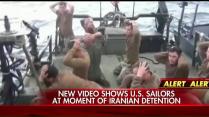
• sailorsAt best it warrants only a footnote in this nation’s proud sporting history, but you need to be aware that in 1985 I jointly won the Enfield Lawn Tennis Club’s Under-16s doubles trophy with my mate, Jason Caddis. Of course, achievements of this magnitude don’t just happen by accident.  No, they take many afternoons whacking tennis balls in the back garden, some of which would sail over the fence onto Mrs Cuomo’s lawn next-door.  Why do I mention this? Because there was more bureaucratic foot-dragging and mutual suspicion involved in negotiating the safe return of my tennis balls than was exhibited yesterday by Iran and America over the repatriation of the US sailors who had strayed into Iranian waters.

    I wonder why. On the one hand, the rapprochement between the two countries has lost no momentum since the historic deal in July last year regarding Iran’s nuclear ambitions. The International Atomic Energy Agency adopted a resolution in December over the outstanding thorny issue of Iran’s ‘possible military dimension’ to her nuclear energy programme. It concluded that the “coordinated effort” to develop a nuclear weapon ended in 2003.

    But on the other hand, there are last-ditch efforts in the US Congress to block the easing of sanctions on Iran and the deal has not been universally welcomed in that country either. As Norman Lamont told the Conservative Middle East Council (CMEC) round-table on Iran recently, many in the country fear a toxification of Western culture. Furthermore, if any ‘peace dividend’ of the release of an estimated $100 billion in frozen Iranian bank accounts is not felt by the population fast, President Hassan Rouhani could be fatally undermined. The hawks are waiting to pounce, says Ali Ansari, Professor of Iranian History at St Andrews University. “How much foreign policy is for foreign consumption?” he asked at CMEC. Without a consensus  between Rouhani, the Supreme Leader Ayatollah Ali Khamenei and the Revolutionary Guard Corps, the ideological custodians of the revolution, the deal would never have happened in the first place. That goodwill could easily dissolve.

    So the idea of an enduring nuclear deal, money-taps turned on and a moderate and pragmatic guy in charge could easily turn into a nightmare. A diplomatic spat over navigationally-challenged sailors could have been all it needed. There is, after all, a Pavlovian response to the word ‘Iran’ from many in the US, according to Nicholas Soames, Chairman of CMEC. Hence the flurry of diplomatic activity to contain the situation. (John Kerry, US Secretary of State, thanked Iran for their “cooperation and quick response”.) But such a demonstration to the world (and internal audiences in both the US and Iran) of mutual respect and a workable relationship was helpful. Perhaps even stage-managed, if you fancy indulging your inner conspiracy theorist.

    Shashank Joshi, Senior Research Fellow at the Royal United Services Institute, a think tank, says that Iran (i.e. Rouhani) cannot let the deal falter. Iran is currently facing crises in Yemen and Syria (where it has thousands of troops), a potential split with Russia over the future role for Assad and a question mark over its relationship with Hezbollah. So the benefits of a lifting of sanctions are clear.

    But how overt can the West make its support for Rouhani without (a) undermining him in the view of the hardliners, (b) cosying up to a country killing thousands of anti-Assad fighters in Syria or (c) adding to existing Saudi fears that having got rid of Saddam the West is actively encouraging shiism?

    Don’t forget that as soon as the banking sanctions are lifted, Iranian oil will flow into an already saturated market, where the price has collapsed from $100 a barrel last year to $30 today. Saudi Arabia is content to see the black stuff go cheap so it can make whatever it can before the days of easily extracted oil ends – 30 years? But as Iran has a much more diverse economy than Saudi Arabia, hastening the end of easy-oil will only add to the tension between the two countries as Iran would likely fair better economically.

    So, huge imponderables and challenges ahead for a region already on fire. The nuclear deal will very likely increase the tension within Islam. But as Norman Lamont said, the deal is worth having (and sanctions lifted) as it will prevent Iran from having nuclear weapons; it’s not about trying to solve all the region’s problems. Whether it adds to them is another matter.
  • sport photoFriday the thirteenth puns aside, tomorrow could be a momentous and dramatic day for the world. The International Association of Athletics Federations (IAAF), the athletics governing body, has demanded a response from Russia in the wake of the doping scandal revealed this week in a report by the World Anti-Doping Agency. The head of the IAAF, Sebastian Coe, admitted he was “completely shocked” by both the scale of the doping and the cover-up operations. He is new to the top job (but has held the deputy’s position for seven years), but his decision of whether or not to sanction Russia – named in the report as the chief offender – could have implications that reverberate even further than a doped-up, muscle-bound, unnaturally hirsute Russian female shot putter could hurl her four kilos.
    Unsurprisingly, Russia’s immediate reaction to the call for exclusion from all athletics competitions (including next summer’s Olympics) by the Canadian Dick Pound, author of the 335-page report, was dismissive. Continuing the recent communications strategy from the Kremlin of brushing off all criticism by questioning the motives and competence of the dissident voices and brazenly rejecting any suggestion of wrong doing, no matter how compelling the evidence, Russia initially denied the claims in the report. This position has since been revised – to a degree – with President Putin ordering his country’s athletics officials to root out any bad practices. Vitaly Mutko, Russia’s Sports Minister, said “we have nothing to be ashamed of. We have problems, but we’ve never tried to cover them up”. It is doubtful whether the IAAF will agree.

    Which leaves Sebastian Coe with a problem. Any ban, regardless of length, will be met with uproar by Russia. But if he feels strongly enough to impose a sanction without going so far as to ban Russia from the Rio Olympics next year, there will be howls of protest from those wanting a stand taken over doping in sport. So let’s assume, for a moment, that Russia is kicked out of the 2016 Olympics. Hold that thought.

    The IAAF are not the only world sport governing body feeling the heat right now. Football’s equivalent, the Fédération Internationale de Football Association (FIFA) is reeling after widespread accusations of graft and dodgy practice. FIFA’s head, Sepp Blatter is currently suspended whilst investigations into corruption roll on. The decisions to award the 2018 World Cup to Russia and, bafflingly, the 2022 tournament to Qatar are being scrutinised. FIFA need to demonstrate the organisation has turned the corner, swept away the illegal practices and is a clean, reputable and responsible body.

    What better way then, than to follow the spirit of the IAAF’s (possible) example by fundamentally overturning hosting decisions. Qatar 2022 is already looking doubtful. But If the IAAF point a scornful finger at Russia, would FIFA sniff an opportunity? Strength in numbers is always an attractive policy, especially when you are trying to convince a global audience. So, might they take the very controversial decision to strip Russia of the 2018 World Cup? And if they did, what could the world expect by way of response?

    Russia is currently hurting. Sanctions are biting and the oil price has collapsed. Crimea and Ukraine have been two successful foreign policy adventures (as far as Mr Putin is concerned) but there are domestic grumblings. There is even the suggestion, from a surprising number of Russia-watchers and nationals alike, that the crash of the Russian airliner in the Sinai last week was orchestrated by the Russian state. I don’t buy that personally, but I have been shocked that the suggestion has been spoken of by many outside the usual conspiracy-theory brigade.  So if Russia were to suffer the double ignominy of expulsion from Rio 2016 and the loss of the 2018 World Cup and given the current political climate, could we expect a reaction in an altogether different arena?

    NATO defences have been repeatedly probed in the last few years and just three weeks ago Russia’s ambassador to London, Alexander Yakovenko, said that, as all political contacts with the West have been severed, “the only sphere left is culture”. An overt threat against NATO is out of the question, even accepting Russia’s love of heavy metal. But a more subtle, obfuscated attack might be a possibility. Georgia suffered waves of cyber attacks prior to the fateful and very brief war with Russia in 2008. Could the same (less the actual shooting war) be expected in, say, Estonia, or another Baltic state, an area traditionally considered (by Russians at least) to be in their sphere of influence? Outlandish? Possibly. But ridiculous? Before Crimea, Ukraine and the shooting down of Malaysian Airlines MH-17, I would have agreed. But if Russia loses both the Olympics and the World Cup who knows?

    Sebastian Coe has a big decision to make tomorrow.

  • Scan0007-2What do the words asylum seeker mean to you? In the current climate it is a politically loaded term; a conflation of economic migrant and refugee. The crisis facing Europe today is at once easy to understand yet impossible to meaningfully comprehend, let alone solve. The phrase has been purloined by those less interested in the plight of the individuals than for the political capital to be made from a good bout of tub-thumping demonisation.  But how serious do you think our mainstream politicians are in debating the issues and trying to do the right thing? My confidence has been shaken by the letter I received (pictured above) from Harriet Harman MP, my member of parliament, over a case I took to her regarding a friend of mine in Yemen, in similarly deep trouble to those fleeing Syria.

    I met my friend Adim (not his real name) when I attended the Advanced Command and Staff Course at the UK’s Defence Academy a few years ago. Adim is a Yemeni national, a fluent english speaker and very intelligent man, albeit with a dubious taste in shoes. He’s a good guy. His country is currently in the grip of a regional proxy war, in all but name, between Saudi Arabia and Iran. In September last year Houthi rebels, backed by Iran, seized the capital, Sana’a, and now control all the major organs of state. Of course, the situation is more nuanced than I give it credit or column inches for, with Da’ish (or ISIS) and other armed groups also involved, but that’s the nub of it.

    Although under suspicion from their new Houthi masters, Adim and many of his colleagues were, initially, tolerated. Steadily though, harassment built up against perceived supporters of the ousted regime. Adim moved his family out of their home last December and some of his fellow officers have been killed or disappeared (as have their children). Adim has not been paid for months and has resorted to dressing as a woman so as to hide his identity and allow him to move around. He has also been shot at. He is obviously very afraid for the continued safety of his family and wants out.

    Having tried a number of options in various countries he reached out to me. I took the issue to Harriet Harman, hoping she would encourage the Foreign Office to issue a visa for Adim, thereby allowing him to travel to the UK and seek asylum. I was confident that he would work straight away, possibly on the staff of the Defence Academy, adding valuable perspective and experience to our military training. And yes, I offered to provide accommodation.

    It is at this point (if not before) many will call me naive and/or daft and the discussion could fracture into well-rehearsed arguments on all sides. But it boiled down to this: there’s not much I can do to help the millions running from persecution and violence, but I could, perhaps, help one family. So I made a decision, discussed it with my wife and acted. I’m not interested in the reductionist politics of the Farage brigade (“so, how many homeless people have you housed?”); he was a friend in genuine fear for his life and those of his family.

    To be honest, I was not expecting to be successful, at least not straight away. But what I was not expecting, as you will see from the letter above, was the wilful missing-of-the-point employed in the let down. To dismiss the issue with a breezy and simplistic ‘I am not in a position to assist [Adim] as he is not residing in the UK..’ cannot be ignorance; Ms Harman is far too intelligent for that. I cannot see it as anything other than being too difficult, too political. He is not residing in the UK – that’s the whole point; I’m trying to get him here so that he and his family are removed from a situation of grave danger. If there is any doubt that Adim is, in fact, hoping to be an economic migrant, I will personally pay his air fare back. But let’s get him and his family over here to discuss the issue in safety first. Politicians like to remind us of the proud history the UK has of offering sanctuary to refugees and the oppressed. It seems the bar for qualifying for such sanctuary is set very high.

    Still, as the letter ends, ‘if I can be of help or assistance in the future with any other matter please do not hesitate to contact me.’ Nice to know.

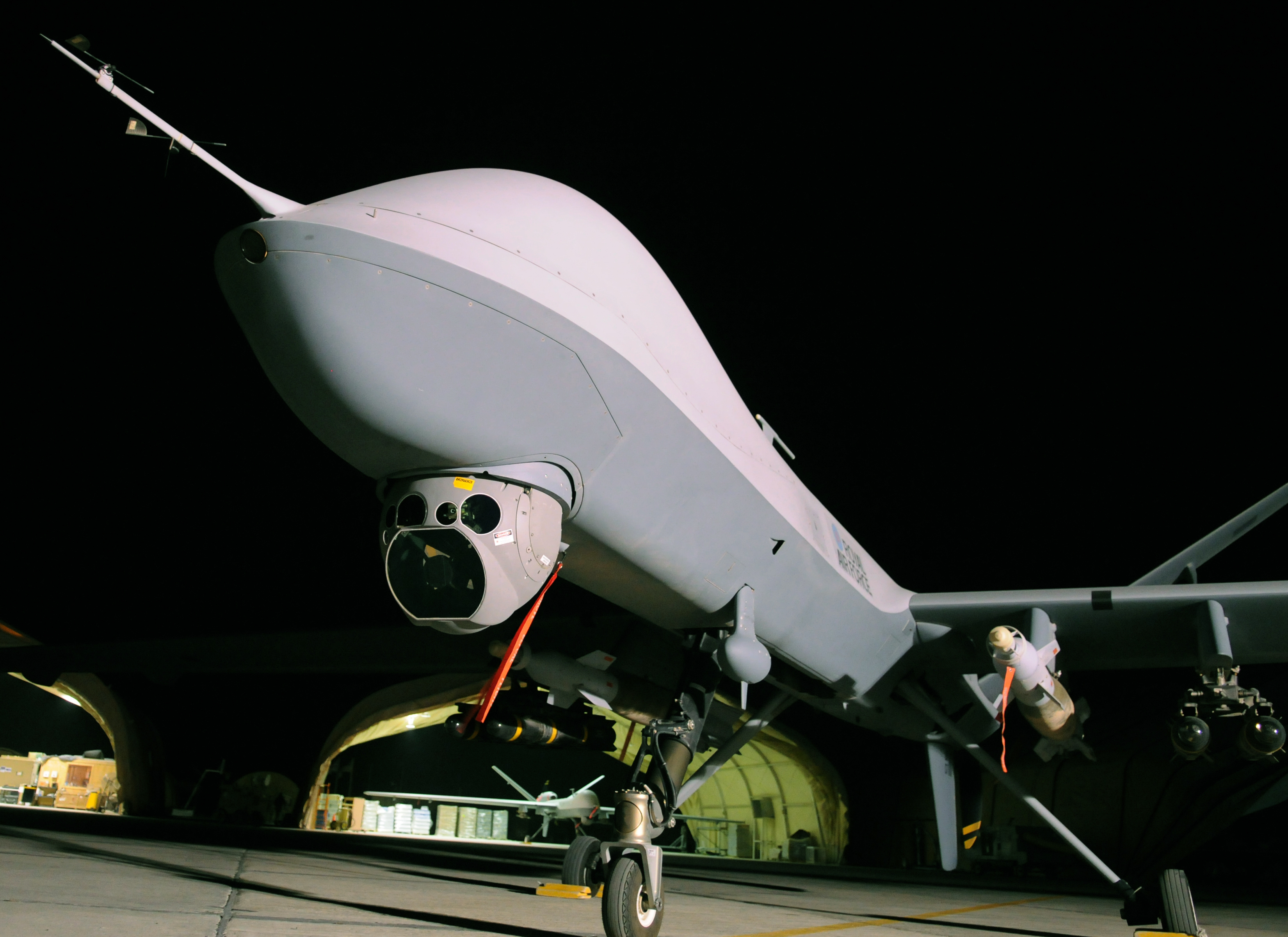
  • Reaper UAVThe fascinating dissertation I wrote for my MA in Defence Studies in 2012 discussed the tricky grey area where morals, technology and military necessity overlap.  The premise was that, for the last ten years at least, technology has pushed military capability far beyond that which society at large understands, or, in many quarters, would accept if they knew what was happening. The chief baddie and the easiest thing to point a finger at as an example of this challenge to the norms of international law, I suggested, is the drone.  So I have been following with interest the fall out from the RAF’s drone strike which killed Reyaad Khan and Ruhul Amin, two British nationals, in Syria. And I think that this incident, although not new militarily, will go down as the watershed moment for nudging forward society’s understanding of the legality or otherwise of targeting civilians with lethal force.

    The debate about whether such a strike is legal or not comes down to differing interpretations of the laws governing war. Broadly speaking, military professionals use the term ‘Law Of Armed Conflict’ (LOAC) whereas the humanitarian and human rights community prefers ‘International Humanitarian Law’ (IHL). As Matthew Evangelista noted in his book Law, Ethics and the War on Terror, the choice of words indicates how the groups regard the sources and purpose of law in the international system. Crucially, both are overarching terms for the same laws just with a different emphasis, so there shouldn’t be much room for disagreement, right?

    As you might expect, no, not right. The fundamental difference is the understanding of the relationship between the individual and the state; a condition further impacted by the introduction of Human Rights Law (HRL). Does LOAC trump HRL? Or are human rights always present, even on a battlefield? And what if the battlefield is Paris, London or Madrid and the adversary is a civilian who believes himself to be at war with the state? HRL suggests the individual has rights; LOAC suggests he has responsibilities. Most importantly, HRL says rights are given to everybody, at all times, regardless of the situation; LOAC links many of its protections to status, differentiating between civilian and combatant. Neither can be proved to be correct, or legal; it is all about interpreting the situation and the response.

    To be completely accurate, as the UK is not a participant to the armed conflict in Syria the RAF strike was conducted in national self defence in line with Article 51 of the UN treaty. The British government said the individuals were involved in planning a terrorist attack that amounted to an imminent armed attack by non-state actors against the UK.  As the Syrian government was either not inclined or not capable of taking the appropriate action within its borders, the British government decided the circumstances of necessity and proportionality justified the action.

    The International Committee of the Red Cross (ICRC) is the de facto guardian of International Humanitarian Law. It has drawn up a series of guidelines delineating civilians from combatants and suggests circumstances under which civilians can be targeted with lethal force. Encouragingly, most countries have adopted the ICRC’s position. The ICRC says that a civilian cannot be targeted unless he or she has taken a direct participation in hostilities. This direct participation is expressed in a number of ways which collectively describe an individual who is very closely linked to hostile acts of significant violence (usually lethal). So, a man planting a road-side bomb would lose his protection as a civilian as the bomb is likely to be an immediate risk to life and it wouldn’t be a threat but for the direct involvement of the man burying it. Conversely, civilians working in armaments factories continue to enjoy protection from harm even though, cumulatively, over the course of their working lives they would have created or assembled a huge number of devices which would cause harm to an enemy This is because each individual act, or day’s work, is not significantly, and immediately, harmful to an enemy.

    But when does this ‘direct participation’ cease? Consider the following scenario: a targeted person on the ground sees and hears a drone and makes obvious signals of surrender: raising hands, perhaps displaying a banner. As a civilian or combatant subject to the rules of war, displaying a clear intention to surrender renders an individual protected from attack. But for the party operating the drone to not carry through the attack would be to give the individual on the ground a very easy way of never being targeted.

    This is the heart of the issue governments are grappling with as they try to combat terrorism perpetrated by individuals who are combatants one minute and civilians the next. For how long after putting down the rifle can an individual (now a civilian once again) be targeted? One minute? One day? Never? And if a military force has identified a civilian as routinely taking part in hostilities and there is nothing to suggest he is about to change his ways, is he targetable when going about his business farming his fields or sleeping in his house?

    Technology now allows lethal action to be employed at great distance against civilians known to be directly participating in hostilities. Unfortunately, society’s awareness of international law has not kept pace with military capability. The laws are sound, but society has yet to discuss in sufficient detail the ethical and legal issues thrown up by this brave new world. If, as the British government explained, the two jihadists were directly participating in hostilities and were so influential that they provided an immediate and grave threat to the UK, then their killings were legal under international law. Many will be uncomfortable with that reality. But make no mistake; it is the new reality and we will see a lot more of it.

  • 20150618-MuseveniI wrote this article for The Economist, based on my Ugandan trip.  It can be seen in the paper here.

    THE buildings stormed by Israeli commandos in 1976 still stand on Entebbe airfield. Now they are joined by the occasional C-17 Globemaster of the United States Air Force, part of an American presence trying, among other things, to hunt down the Lord’s Resistance Army. Over the years, Uganda’s allies and foes have chopped and changed.

    But one fact stubbornly endures: since independence from Britain in 1962, Uganda has never experienced a peaceful transition of power. In the coming year though, opponents of President Yoweri Museveni think they at last have a chance to unseat him at the ballot box.

    In 1986 Uganda’s current ruling party, the National Resistance Movement (NRM), emerged victorious from a protracted civil war that had started with the ousting of Idi Amin in 1979. Mr Museveni, as the NRM’s head, has been president ever since; 80% of Ugandans have known no other leader. Many Ugandans care less about past glories than the frustrations of the present, especially over corruption, jobs and housing. But a divided opposition has provided no plausible alternative and, in any case, removing Mr Museveni through the ballot will be difficult. The NRM is woven into the fabric of Ugandan society and has a long reach. Opposition parties may continue to find it hard to compete against it, even if many Ugandans are no longer enthralled by Mr Museveni. Even so two recent events raise the possibility that an election due next year may offer a change.

    On June 9th the main opposition parties and civic leaders came together to form the Democratic Alliance (DA). Similar groupings have emerged before but have failed to dent the NRM. This time lengthy consultations and a wide acceptance that only unity can lead to change have created a more resolute collaboration, says Zac Niringiye, a former Bishop of Kampala. “I do not hate Museveni,” he says, “I love him because he is a human being. But he is the source of all instability and needs to go.”

    Another development is the declaration on June 15th by Amama Mbabazi, a former prime minister and chief thorn in Mr Museveni’s side, that he will fight for the NRM’s nomination as presidential candidate in place of Mr Museveni at the party’s convention on October 4th. As a leading NRM figure he hopes to win support from party members thirsting for change. But Mr Museveni knows a thing or two about holding on to power. The NRM is full of bigwigs who owe their positions to the president. Challenging from within the party is a risky strategy.

    Should the NRM stick with Uganda’s longstanding president, Mr Mbabazi says he may talk to the DA. But having been at the hub of power so long, he may struggle to win over the anti-NRM vote. Whether he is the man to offer it or not, change is needed, especially at the top.

  • 20150614-amamaSacked Prime Minister challenges Ugandan President’s 29-year rule

    Kampala. 15 June 2015.

    The former prime minister of Uganda has declared he will challenge the president at elections due next year. Amama Mbabazi was sacked from the government in 2014 after criticising the president, Yoweri Museveni, who has been in charge for 29 years.

    Mr Mbabazi, 66, told me there is a “climate of fear” in the country and that change is desperately needed. He accuses Mr Museveni of centralising power, intimidating the press and misusing public funds to ensure re-election.

    Launching his presidential bid on June 15th with a slick social media strategy, he hopes to reach out to the youth of Uganda who feel ignored by the country’s increasingly authoritarian president. 80% of Ugandans have only known one leader.

    Mr Museveni, 70, has been in power since 1986 after he led a resistance movement to victory in Uganda’s protracted civil war, which started with the overthrow of dictator Idi Amin in 1979. Amin, who called himself King of Scotland to highlight his anti-English views, ruled the country from 1971 and was responsible for the deaths of hundreds of thousands of people.

    Since gaining independence from Britain in 1962 there has never been a peaceful transition of power in Uganda. Mr Mbabazi hopes to overcome widespread voter apathy in a country that has only known multi-party elections since 2005. Uganda has no Presidential term limits and Mr Museveni has taken advantage of a disparate and weak opposition to remain in charge for so long.

    He had promised to stand down after winning the 2011 election, but went back on his word. In February 2014 at the annual convention of the ruling party, the National Resistance Movement (NRM), Mr Museveni declared he would stand unopposed at presidential elections planned for early 2016.

    In a rare display of independence, the party’s Central Executive Committee ruled the president’s comments unconstitutional and said other NRM members should be able to stand. But with widespread cronyism Mr Museveni has been able to dissuade serious challengers.

    Mr Mbabazi has long been a thorn in Mr Museveni’s side. As a member of the NRM since the days of the bush wars and having previously held positions including Defence and Security Ministers, he has credibility within the party and has been at the centre of power for many years.

    He therefore thinks he has a good chance of securing the party nomination at the next convention, due on October 4th this year. He says Mr Museveni has “overstayed his welcome…and this has many dangers.” He promises that, if elected, he will serve a maximum of two terms.

    In a separate development on June 9th, Uganda’s main opposition parties and civic leaders announced the formation of the Democratic Alliance (DA). Previous collaborations have proved weak and no match for the NRM party machine.

    But this time discussions took place over two years and there is an acceptance that only by unifying can Mr Museveni be ousted. One member of the group is Zac Niringiye, the former Bishop of Kampala. He has been a long-standing critic of the president and believes his life has been threatened in the past for his outspoken opposition. He only drinks in one hotel in Kampala where he says, “I know the coffee is not poisoned”.

    “Museveni has deceived the people and the West into thinking he is the bulwark against terrorism,” he says. “But really he is the source of instability in this region of Africa.”

    The Bishop alleges Mr Museveni deliberately tolerated the existence of the Lord’s Resistance Army, a brutal rebel movement in central Africa, so as to appear strong for the West. Likewise, Uganda’s efforts against al-Shabaab in Somalia are part of a strategy to win over international support.

    The United States has a military presence in the region and planes often fly out of Entebbe airfield, scene of the famous Israeli commando raid in 1976. Bishop Zac says Mr Museveni uses such international influence to lend legitimacy to his tenure.

    “I do not hate Museveni,” he says, “I love him because he is a human being. But he is the source of all instability and needs to go.”

    It will be the youth of Uganda who decide the election. For them corruption, jobs and housing are more important than former military glories in the bush wars. Uganda has the second largest youth population in Africa, after Chad, and a climate favourable to food production. It therefore has potential as an exporting nation, but suffers 83% youth unemployment.

    In the Budget on June 12th, the government prioritised 1.6 trillion Uganda Shillings ($0.5billion) for security and defence, instead of the economy. Mr Museveni said that agriculture would benefit through “forward and backward linkages”. Many think the money was pledged to shore up his position. “How can there be so much unemployment,” asks Angelo Izama, a journalist with The Monitor in Kampala, “when there is so much work to do?”