• Conflict “has the potential to wrestle morality” from soldiers, a senior officer has said, as the army expands mental health resilience training to prevent ‘moral injury’.

    Brigadier Paul Tedman, Deputy Commander of the MoD’s Joint Helicopter Command, said the army was working hard to bring moral training “to a really fine edge”.

    “The challenges of preparing people for combat both physically and morally [are] intertwined,” he told the Telegraph.

    The army has expanded its programme to optimise performance on the battlefield. 

    Operation SMART (Stress Management And Resilience Training), a through-career programme for mental fitness, starts in basic training.

    The programme has different modules for different stages in a soldier’s career and uses mental resilience techniques taken from elite sport psychology. 

    Soldiers at all ranks are taught how to recognise the signs of poor mental health in themselves and others. Lessons on suicide prevention are drawn from a programme jointly designed with the Samaritans.

    Brig Tedman said: “We have conversations about the ethical dimension all through training.

    “Conflict has the potential to wrestle morality from the abstract and political into reality for pilots and it’s really important that we understand that from training through to combat and the aftercare required to deal with it.

    “Apache is an offensive platform and is deliberately putting fire down to do harm to people.

    “Soldiers are intelligent, tough and inquisitive. It’s not just about the ‘what’, these days we have to be able to explain the ‘why’ too.”

    Will (not his real name), a former Commanding Officer of an Apache Attack Helicopter Regiment said many in Defence would welcome mental health resilience training.

    “It definitely wasn’t there when I was in the middle of it,” he said.

    “When I went to Libya [in 2011] I was killing hundreds of people every day. And there’s no processing for that, it was lacking.

    “Some really big personalities were putting their hands up and saying ‘I’m full. I need a bit of help with this’. It wasn’t PTSD, it was just people needing to process stuff.

    “We as a corporation hadn’t equipped people with the ability to process things.”

    The Army’s Senior Health Adviser says Operation SMART is part of the duty of care the MoD has to “ensure people are properly prepared, both physically and mentally, for the arduous tasks that we place on them”.

    Brigadier Tim Hodgetts, who says his own mental health resilience was boosted through his experience of being caught in an IRA explosion in 1991that killed two soldiers, believes the army’s programme allows people to have “difficult conversations”.

    He says the army is now keeping pace with society regarding mental health awareness, thanks partly to celebrities and the Royal Family speaking out on such issues. 

    Colonel Tim Boughton, the strategic adviser to the army on mental health, says his background in neuroscience and mindfulness-based cognitive therapy helps him explore these issues with those in positions of command. 

    So far around 800 senior officers in the army have attended the sessions.

    “Senior leadership can be a lonely place,” he says. 

    “Self awareness leads to influence and then to control. It’s key because a lot of the senior officers haven’t got the self awareness to know what it is that’s going wrong or the issues that they’re having.

    “When they do, they have the influence to be able to do something about it.”

    Colonel Boughton says moral injury refers to the harm an individual suffers after an act of perceived moral transgression. He says it can produce profound emotional guilt and shame, and in some cases lead to a sense of betrayal, anger and moral disorientation.

    “When you look at the stress container of life, we’re effectively giving [soldiers] a tap on the side that they can turn on to allow those issues to calm down.” 

    He says it was only when the intervention of his wife that eventually led him to seek help for PTSD. 

    “We are still in an area where men are less likely to talk about mental health issues than women.

    He worked with the Samaritans to establish a system whereby a veteran or serving soldier can identify as such to be connected to someone with a military background after calling 116123. 

    “If you think something is wrong, just talk about it,” he says.

    “If you feel that you’re not sleeping well, and you’re being argumentative, start a conversation.

    “You won’t be judged, you can just check in.” 

  • The RAF has flown the Brexit deal document from Brussels to London for Boris Johnson’s signature.

    I have it on reasonably average authority that the choice of an aircraft from 32 Sqn (The Royal Flight) was only one of a number of options considered…

    We join an urgent Zoom call between Sara Oizys (SO, a junior civil servant in Number 10), General Walter ‘Woolly’ Cardigan-Fitz-Snuggly (WCFS, Head of the Army), Admiral Jack Speek (JS, Head of the Royal Navy), Air Chief Marshal Baz East (BE, Head of the RAF) and Gwyn ‘Throaty’ Slasher (rank not disclosed – TS, Director of Special Forces).

    SO: Good morning gentlemen. We’ve got an urgent mission from Number 10. The PM wants you to get a doc out of Brussels.

    BE: I see. Well, as an Executive Member of the Organisation for the Prohibition of Chemical Weapons I expect Belgium would have docs essential to pushing back against the Russians. 

    SO: It’s not that kind of doc.

    JS: Understood. So, someone critical in the Covid fight then?

    SO: No, it’s not Covid. Or Russia.

    BZ: Acknowledged. What is it then?

    SO: Brexit.

    WCFS: SAY AGAIN, OVER.

    SO: It’s the Brexit doc. And General, please stop shouting.

    JS: There isn’t a Brexit doc. Unless you mean a specialist in national psychiatry, the entire country’s been driven ga-ga by the whole thing.

    SO: No, I mean it’s an actual doc. The document the PM has to sign to make the Brexit deal with the EU work.

    BE: So not a live doc then?

    SO: No, it’s a piece of paper. The Brexit deal.

    WCFS: DEFINITELY NOT A LIVE DOC THEN.

    SO: I can’t comment on that. And General, please stop shouting.

    JS: Throaty, you’re on mute. And take your balaclava off.

    TS: Negative. I just like to keep my own counsel, see?

    SO: Gentlemen, the mission, please.

    BE: Should be easy enough. I’ll get the chaps – and chapesses, sorry Wiggo – on it now.

    SO: Air Chief Marshal stop, you can’t tell anyone about this.

    BE: Can’t tell anyone? Why not?

    WCFS: THIS IS TOP SECRET.

    SO: It’s classified higher than that. And General, please stop shouting.

    JS: You don’t mean…

    SO: Yes, Tippety-Tip-Top Secret Level 10. You can’t tell any non-essential personnel.

    BE: Serious then.

    SO: Yes, friends and family only.

    JS: If it’s secrecy you’re after I’ll rustle up one of the Astute Hunter-Killer subs. Nobody will see it.

    SO: That sounds good Admiral. Which one.

    JS: HMS Agincourt should be ready.

    SO: Not quite the hand of friendship.

    JS: HMS Audacious?

    SO: Well, the bold and risky line fits.

    JS: HMS Agamemnon?

    SO: He prolonged a war and increased everyone’s level of suffering. Perfect. 

    BE: Rubbish! I’ll whistle for an F-35 stealth fighter. It’ll be back here before you can say ‘no loose items in the cockpit’.

    WCFS: TANKS. YOU NEED A TANK. ONLY WAY TO GUARANTEE IT GETS THROUGH.

    SO: General, you’re fighting the last trade agreement not this one. Challenger 2 is so old it won’t make it. And please stop shouting. 

    Throaty Slasher has been chuckling throughout the conversation and sharpening something just hidden from the camera; probably a pencil.

    TS: Put your toys away gents. What you need on a mission like this is cold steel.

    SO: You don’t mean…

    TS: Yes, the Porsche Cayenne sat in the SAS driver training fleet. Hardly ever gets used. I’ll get Lofty, Dinger and Fingers to give it a run out. 

    SO: I don’t think so. They’ll trip over their flares for one thing – they all think they’re in the Sweeney circa 1977.

    WCFS: CAN’T WE USE THE FAX? WE RELY ON BOTH OF THEM IN ARMY HQ BUT YOU CAN BORROW ONE AFTER THE RACING RESULTS HAVE COME THROUGH.

    JS: Ships! The Type 32 is so stealthy it’s basically just a doodle on a fag packet.

    BE: Air Force! We’ll zap the doc over a couple of satellites just to show we’re in space.

    WCFS: THE LAST SIX INCHES OF DEFENCE POLICY ARE MADE OF STEEL. 

    JS: What does that even mean?

    WCFS: NO IDEA.

    SO: Covid has cost the Treasury a fortune and we’ve no idea of the economic impact of Brexit yet. I think we better save the taxpayer any further pain. I’ll book a ticket on the Eurostar.

    At this point the government data system cut out. The only reliable means of communication was the fax machine in Army HQ, but that kept giving the ‘busy’ tone.

  • Neighbours who failed to stick to Covid-19 isolation rules could be shunned when lockdown is over, the author of a research paper about Prisoners of War has suggested.

    Lessons from a new study of American captives from the Vietnam conflict suggest there could be a backlash against members of society judged to have endangered the wider social group by their actions during the coronavirus crisis.  

    Many of the mechanisms for coping with the mental stress of isolation in Vietnamese prison camps, such as the notorious Hỏa Lò Prison, which became known as the Hanoi Hilton, are applicable to modern society, according to the lead researcher. 

    Athena Jones, a PhD student of Clinical Psychology at the Loma Linda university in California, said American prisoners of war (PoW) with optimistic mindsets who were determined to reconnect with family and friends experienced better long-term mental health outcomes. 

    Such lessons have direct relevance to modern society moving out of lockdown, she suggested. 

    “We’re social creatures, so we crave human connection,” Ms Jones told me. “That’s what can be really challenging in isolation at the moment, especially if you’re living alone.”   

    However, just as some PoWs who had willingly cooperated with their captors were shunned by the wider group for violating unwritten rules, Ms Jones warned modern society could show similar attitudes after lockdown. 

    “There could be a backlash, especially when fear is involved,” she said.

    “The PoWs were very upset at the other PoWs who gave in and cooperated with their captors because that really wasn’t honorable, nor in the best interest of the entire group. 

    “Here, many people are extremely upset at individuals who are holding large gatherings or otherwise ignoring the isolation orders because it’s not in the best interest of the whole group and ‘flattening the curve’ [of infection].

    “In the future there may be more backlash towards those groups or those who try to end isolation too early and thus put everyone else in danger.”

    For a paper just published in The Military Psychologist, the newsletter of the Society for Military Psychology, Ms Jones and her team interviewed former captives from the Vietnam war. The length of captivity among the group varied from 101 days to over seven years. 

    Participants were asked about their experiences in captivity and how they reintegrated into society after their release. They were also quizzed on how their attitudes may have changed over time. 

    Results showed that having a ‘rationally optimistic’ mindset helped them survive the ordeal, a lesson applicable to the world after the Covid-19 pandemic, Ms Jones suggested. 

    “There is a lot of research saying that optimism is associated with better physical health, immune function and so on,” she said.

    “They [the PoWs] accepted the idea of being aware of their situation but knew that to dwell on it would take up a lot of energy.

    “Instead of dwelling within an experience the individuals avoided the worst parts of the situation they were in, in order to put their energy into survival.”

    One remedy the captives came up with was the ‘tap code’ for communicating with each other. 

    Each PoW had to imagine a five by five grid square containing the letters of the alphabet; A to E in the top row, F to J in the second and so on (C and K were interchangeable). By tapping on pipes or walls they were able to send messages or just feel close to each other.

    One participant in the study, ‘Steve’ said: “We were fanatics at communication.

    “Anybody that was being tortured and put in solitary, we had ways to finally get to them and a way that they could at least see us at a distance.” 

    The modern day tap code during coronavirus lockdown could be a Zoom meeting (a video messaging service), Ms Jones suggested, “as a means to maintain the communication” with family and friends. 

    The study also suggested negative events that are temporary and outside the individual’s control don’t have to be carried forward once the situation is over. “Even if I wanted to go out, things are closed,”Ms Jones said. “That choice has been taken away from me.”

    Instead, we should all emulate the ‘rational optimism’ displayed by the PoWs in response to the present situation, she suggested, and accept the need to adhere to social distancing guidelines. 

    The enforced separation from family members that entails is hard, but there are still ways we can connect with each other.   

    “They weren’t all happy and peppy in the camps but they had strength and belief. They set up schedules to eat and exercise,” she said. 

    “Some even prepared to return to society by having dancing lessons with each other.”

  • Credit: Heathcliff O’Malley

    Artificial intelligence can be worth “a thousand Napoleons” for the armed forces – as long as military chiefs understand how to use it, a senior officer has said.

    Advances in technology and the benefits of machine-learning systems offer great potential for the military, provided commanders are able to keep pace with the data produced.

    Dr Keith Dear, an officer in the RAF, says artificial intelligence (AI) could make the world a more stable place if it “presents more of the truth about what is actually happening in any given scenario” as “more transparency should lead to less uncertainty.”

    However, he warns that the predictability of much of human behaviour could be exploited as never before by AI systems identifying vulnerabilities in military decision-making processes, or even in individual commanders, faster than human analysts can.

    “We should not always assume that technological advances will be good for humanity,” Dr Dear told me.

    Speaking in a personal capacity having completed a PhD from the Department of Experimental Psychology at Oxford, Dr Dear believes psychologists and AI computer scientists are in a similar position to that experienced by physicists on the Manhattan Project (the development during the Second World War of the world’s first nuclear weapons).

    Psychology has a leading role to play as AI systems evolve. “Sometimes advances in technology can be profoundly damaging,” he suggests.

    “If we think of ourselves as biochemical algorithms and our decisions the results of inputs leading to outputs, that makes our behaviour probabilistically predictable which allows us to be manipulated in ways which up until now have not been possible.”

    Multiple experiments have shown how easily humans can be manipulated to make errors by presenting information in a particular manner or by overloading the individual with data, he says. Handled poorly then, AI could be a threat to sound military decision-making, he suggests.

    “We are definitely not fully rational, no psychologist would make the argument that we are. It’s the exploitation of those vulnerabilities that concerns me.”

    Dr Dear suggests most Western armed forces have been trying to create a human form of artificial intelligence “as far back as the Prussian staff system” of the early nineteenth century.

    Instead of the French model of relying on the natural elan of a commander to come up with a fantastic battle-winning idea, he says the Prussians decided “not to wait for another Frederick the Great and instead thought ‘we need a system to produce a thousand Napoleons because we keep losing’.”

    The idea was to build military headquarters with very narrow specialised functions to get the maximum out of each individual and to make the decision-making process more efficient and rigorous, and therefore more reliable.

    “That’s what we’re trying to do with AI,” he says.

    Humans, he suggests, are tightly constrained because we can see only a small number of possibilities. Not so computers.

    As an example he points to AlphaGo, a programme developed by technology company DeepMind to compete in the ancient Chinese strategy game of Go. The programme used “other-worldly moves” that no human had ever considered.

    In 2016 it beat the world’s best human Go player by using moves that had never been seen before.

    “As we move more and more into this world of AI, people will become more used to there being things that we can’t explain so well.

    “This is already happening in a highly strategic game that we thought humans would always win at, with the programme doing things we would never do ourselves. It’s not unreasonable to start to wonder what that means.”

    What would be the human response in the run up to any future conflict if an AI system working in a military strategic headquarters recommended such an ‘other-worldly’ move?

    “Because so much of AI is a black box – you don’t see the computational layer; it just has an input and works out, probabilistically, an output – what happens when we get the order to do that and all the evidence from wargaming suggests it usually is right?” he asks.

    “Do we risk lives?”

  • On a training exercise in 2014, Royal Marine dog handler Scott Candlish was working as usual with his animal, Max.

    Both veterans of the war in Afghanistan, Scott and Max were an inseparable team and had complete confidence in each other.

    However, on this training serial something went wrong and both, unfortunately, were left badly injured after a fall.

    Scott, 39, suffered two fractured vertebrae in his back and Max badly damaged his legs. Sadly, due to his injuries and consequent behavioural change, Max had to be put to sleep some time later.

    Scott knew he had to continue working with dogs, even as he accepted his military career was over and as he mourned Max, so retrained as a canine behaviourist and hydro therapist.

    “There was always a void, always something missing, and this is it,” he told me.

    Scott acknowledges his work with dogs has helped his own physical recovery from injury and the loss of a career he loved. The split between treatment for the animal and therapy for himself is “50-50,” he said.

    “I get most pleasure out of helping people watch their dogs recover and prolonging a dogs life so a person doesn’t have to go through the pain I did watching my dog suffer.

    “Dogs go through the same emotional pain as we do when they’re injured, when they’re used to doing something day to day that they enjoy that releases endorphins.

    “[Max] was in so much emotional pain that I had to let him go. He developed behavioural problems, teeth baring, displaying aggression. He never bit anybody but it was coming.

    “He was unhappy. It was time to let him go, and that hit me pretty hard. I put my Squadron badge on him and I was there. He knew. He knew that was his last day.”

    His back injury meant Scott was no longer able to deploy on operations with the Royal Marines and, devoid of the opportunity to work as a dog handler, he left the service.

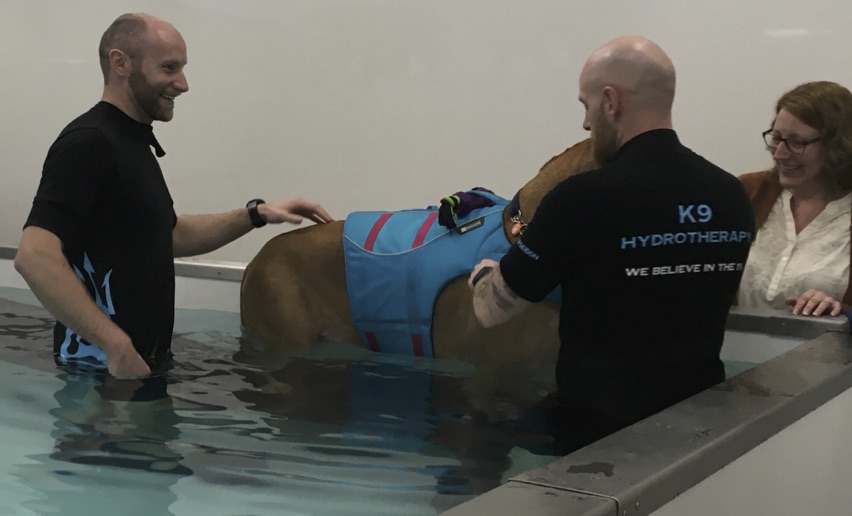
    However, having found hydrotherapy very effective for his personal recovery he believed the same principles could be applied to dogs and set up the Pawseidon treatment centre in Poole with Jimmy Hill, another former Royal Marine dog handler.

    The pair treat injured dogs in a five by four metre pool, or a treadmill in a water tank. They say the warm water and slight current that can be generated by submerged jets is ideal for helping injured animals or those recovering from surgery.

    The canine therapists sometimes play classical music and reggae during sessions as they found the sound can have a noticeable calming effect on some dogs.

    Scott described how he and Jimmy helped a family say goodbye to their dog that had been living in pain.

    “The dog was going to be put to sleep on the Monday so we got the owners in. We brought them in for a free swim – his final swim – and let the owners get in with him, which is out of the ordinary. We sat in the pool with them, had a cup of tea. The owner was really upset, but at the same time really grateful. It was nice for us all. Selfishly, I do get pleasure from helping dogs, it’s not work.”

    Nicky Stazey, from Poole, had brought Thor, a four-year old Great Dane weighing 90kg, to the centre for treatment on inflamed joints.

    She said treatment in the pool to build up muscle tissue had clearly alleviated his suffering.

    “When I first brought him he was literally hiding behind me,” she said. “But he’s come on leaps and bounds. His confidence is through the roof at times…he’s fantastic.”

    Jimmy, 37, was shot multiple times in December 2013 during an operation in Afghanistan which left him with arthritis in his hip and a lower leg injury.

    He lost his dog, a Belgian Malinois, in the same action and eventually had to leave the Royal Marines due to his injuries having endured 16 operations.

    Throughout his recovery, he was unsure what next to do with his life, but “the idea of working with dogs kept coming back like a boomerang,” he said.

    Although he has worked with other animals, such as cats, rabbits and even a ferret, dogs are his real passion.

    “Seeing dogs hurt now and seeing what we can do with the properties and power of water, it’s unbelievable.

    “What we do now is a bit pink and fluffy, but it’s all about having a passion for animals and the satisfaction of helping dogs.

    “There’s a communication you have with animals through therapy and helping them and you can see that they really benefit from that and warm up to you.

    “Even in pain dogs will stay loyal to their owners. They are stoic in their whole recovery journey and I really admire that.

    “Dogs are great at reading our emotions and acting on them to comfort their owners, which in turn helps owners overcome that battle back to fitness.”

    As science evolves vets are increasingly confident practices such as hydrotherapy can offer alternatives to invasive surgery.

    Pet owners too are starting to understand the benefits of alternative therapies, such as canine myotherapy, a form of deep tissue sports massage for animals.

    As Jimmy observed: “There are other ways to skin a cat”.

  • Jeremy-corbyn-christmas

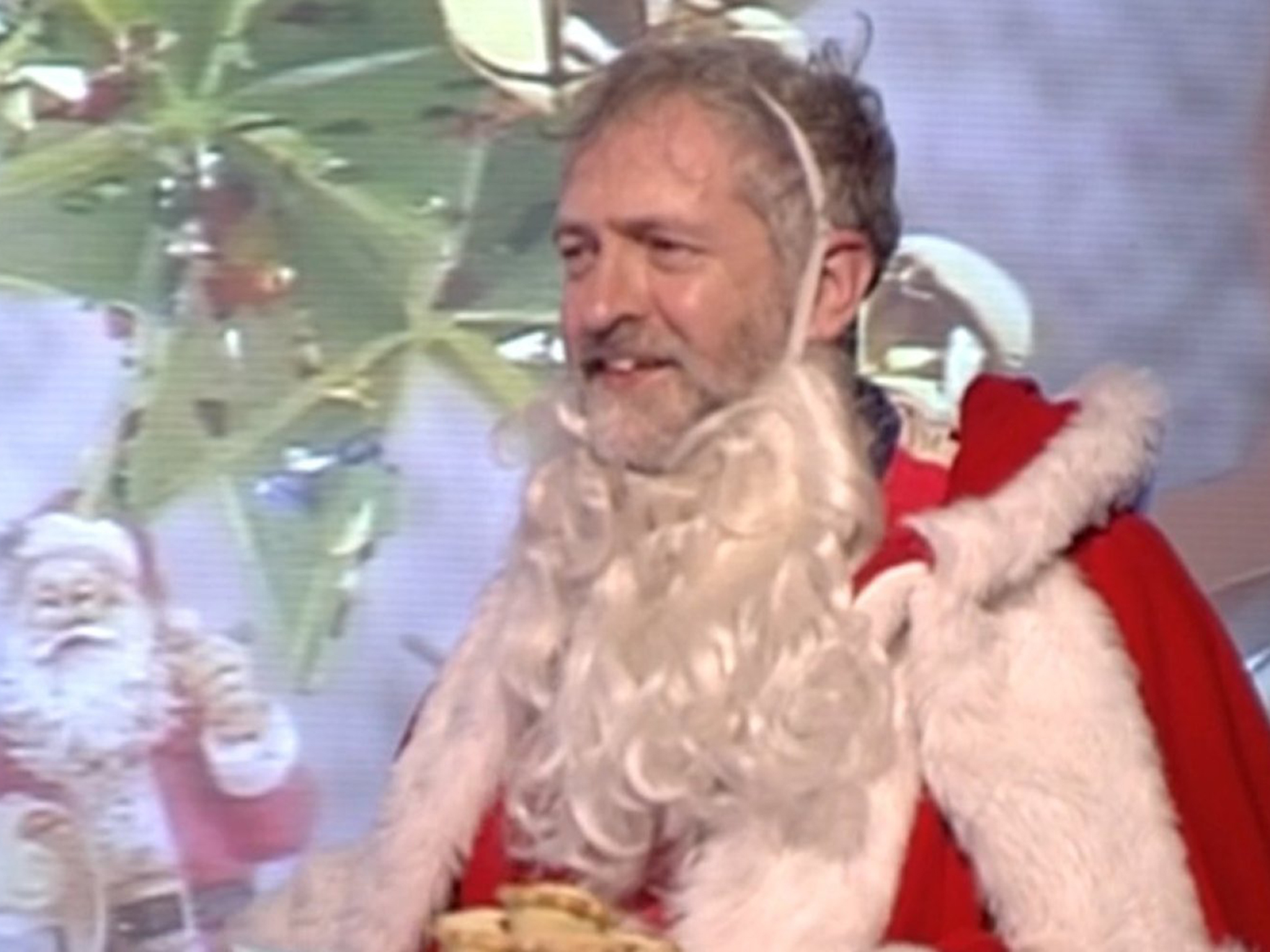
    The scene is set for the Labour Party’s Christmas Carol Service in Party HQ. Jeremy Corbyn is on stage.


    Jeremy Corbyn: Welcome comrades to the Labour Party Christmas party; so good they named it twice!

    Silence around the room

    Jeremy Corbyn: Tories out!

    All: TORIES OUT!!! {general cheering}

    Jeremy Corbyn: Yes, as I said, welcome. Apologies for the extreme brightness in the room; Diane bought a few too many bulbs this year.

    Diane Abbott: I. Decided. That investing. In fairy. Lights. From my local hardware. Store. Was a good idea. But, yes, I spent the. Entire budget. I got confused. With. The. Numbers.

    Jeremy Corbyn: Easily done, easily done, just ask Liam Byrne. But don’t worry, when we’re in power there’ll be more than enough cash to go round, right John?

    John McDonnell: Yes comrades, I’ll order the Treasury to fold all paper notes in half. I did the same myself the other day and thought I had twice as much cash in my pocket as I actually did, ha ha!

    Jeremy Corbyn: Er, quite. Anyway, well done for sprucing up your sunglasses everyone. I think this office is now the brightest thing in the sky; brighter even than the North Star!

    Voice from the back: Actually it’s a common misperception that the North Star is the brightest in the sky…

    Jeremy Corbyn: Yes, thankyou Hilary…

    Hilary Benn: I just feel honour-bound to point out where the leadership has got it wrong…

    Jeremy Corbyn: And I thank you for your insight and honesty; you know how much I welcome feedback and friendly criticism.

    Hilary Benn: Can I just say that…mmmmpfpff..

    Hilary Benn is muscled away from the stage by two black duffel coat-wearing figures in sunglass

    Jeremy Corbyn: I’m glad to see you’ve all voluntarily arranged yourselves into centrally-organised groups for the carols. Let’s start with our old friend and party loyalist – just look at his nose! – Rudolph!

    The gathering breaks half-heartedly into Rudolph The Red-Nosed Reindeer but barely gets through the first verse.

    Voice from the crowd: JEREMY, I’M NOT HAPPY!

    Jeremy Corbyn {squinting into the crowd}: For the love of Marx! What’s that?

    A woman in fancy dress wearing a huge green satin ball with two spiky leaves poking out barges her way to the front of the crowd as the singing dies out

    John McDonnell: It’s Emily. She dresses up as the Holly ‘Thorn’ Berry every bloody year.

    Emily Thornberry: Jeremy, I don’t think we should be celebrating in song the victimisation of workers and encouraging a culture of workplace bullying.

    Jeremy Corbyn: What?

    Emily Thornberry: Well look, there’s plucky little Rudolph, doing his bit, while all the other reindeer laugh and call him names. They won’t even let poor Rudolph join in any reindeer games!

    Jeremy Corbyn: Well I hardly think…

    Emily Thornberry: And then, AND THEN, when the Tory manifesto has really hit the fan..

    All: YAY!!!

    Emily Thornberry: Yes, along comes the first foggy winter’s night and Santa, the work-shy elf-exploiter; the man who has presided over this system of harassment and intolerance; the supposed seasonal expert who hasn’t even winter-proofed his vehicle, has to turn to dear old Rudolph so his red nose can light his way!

    Jeremy Corbyn: Yes, fair point. I’m not having it. There can never be any excuse for the abuse of one reindeer by another reindeer. I have a simple message for Santa and it is this: you wear red, it’s about time you started acting red!

    All: YAY!!!

    Jeremy Corbyn: Thankyou, thankyou. Now let’s try another. Nothing says controversy-free Christmas like the lovely jingling of bells!

    The crowd groans their way into Jingle Bells, but don’t get far.

    Voice from the crowd: THIS IS MODERN DAY SLAVERY!

    Jeremy Corbyn: Hugo’s ghost, what now?

    Shami Chakrabarti: A one-horse open sleigh? Britain has the highest level of adult obesity in Europe and we expect a pair of canoodling fast-food addicts, no doubt carrying gallons of sugary drinks, to be pulled merrily along by one poor horse?

    Jeremy Corbyn: I, er, I thought it was a merry-go-round.

    John McDonnell: LIKE THE TORY FRONT BENCH!

    All: YAY!!!

    Shami Chakrabarti: No, Jeremy, it’s quite clear. Over the fields we go, LAUGHING ALL THE WAY! Well I’m not laughing, and I don’t think the millions of animal-lovers in this country would laugh either if they knew the level of exploitation that was happening in the name of festive fun.

    Jeremy Corbyn: Absolutely Shami. I’ve long demanded a new model of equine management to replace the failed dogmas of neoliberal Christmas celebration.

    John McDonnell: Jeremy, get on with it. They love your speeches but you’ve not yet managed to translate any of their support into completing an actual Christmas song.

    Jeremy Corbyn: Right, right. Well comrades, what could be more trouble-free than a rendition of We Wish You A Merry Christmas?

    Voice from the crowd: As long as we all remember it’s ‘kin’ not ‘king’; the common misperception…

    Jeremy Corbyn: SHUT UP HILARY!

    Len McCluskey leaps onto the stage.

    Len McCluskey: MY MEMBERS REFUSE TO SING A SINGLE WORD UNTIL WE GET GUARANTEES ABOUT FIGGY PUDDING!

    Jeremy Corbyn: Yes, yes, Len, whatever you say.

    Len McCluskey: AND CUPS OF GOOD CHEER FOR ALL MEMBERS!

    All: YAY!!!

    Jeremy Corbyn: Of course Len. John, enough in the kitty for every comrade to have a cup of good cheer?

    John McDonnell: I doubt it, Diane’s blown the lot!

    A mince pie is thrown from the crowd and hits Len McCluskey.

    Voice from the crowd: Clear off McCluskey, you’re the ghost of Labour Past!

    Jeremy Corbyn: Calm down Chuka! Len, willing to compromise on the figgy pudding?

    Len McCluskey: WE WON’T GO UNTIL WE GET SOME!

    All: Ho Ho Ho Je-re-my Coooorrbyn!!! etc etc etc…