• green goldCentral banks and pension funds are embracing green and gold investments.


    “FOLLOW the money,” encouraged the shadowy figure of Deep Throat during the Watergate crisis. His words might be wise counsel today for those worried about a Trump bump in global finances. According to a report issued on June 14th by the Official Monetary and Financial Institutions Forum, a think tank, of the world’s top 750 central banks, sovereign funds and public pension funds almost half the respondents worried mainly about political hazards. Almost a third cited US and wider geopolitical risk as their greatest challenge. Brexit and a renewed euro area crisis accounted for a further 17%.

    Collectively these institutions control $33.5 trillion of global assets, equivalent to 45% of global GDP. That is an increase of 1.4% from 2016 (but still down on the 2014 figure of $33.798 trillion). The Asia Pacific region remained the largest area with Assets Under Management totaling $12.7 trillion; 37.9% of the total. Four investment authorities from the region were in the top 10: the People’s Bank of China, Bank of Japan, Japan’s Government Pension Investment Fund and the China Investment Corporation.

    Relative to sovereign funds and pension outfits, central bank assets declined in 2016. That is partly down to intervention in currency markets to stave off devaluation. In other cases, particularly among energy and commodity exporting countries, reserves have had to fill holes in national budgets, vulnerable to a strong dollar (the sovereign funds of Algeria and Kazakhstan have been particularly badly hit by low receipts from energy exports). Part of the 9% year on year fall in assets of China’s central bank, the People’s Bank of China, was down to investment in the Belt and Road initiative (although it maintained its number one slot with just under $3.1 trillion in assets).

    Two sectors have caught investors’ eyes. Green bond issuance is expected to grow year on year by 30% in 2017, to $120billion, according to Moody’s. Central banks and pension funds in North America and Europe are the most enthusiastic investors, with the latter leading the flight from fossil fuel-related industries. (In 2017 Norway’s sovereign wealth fund divested 10 companies with significant exposure to coal.)

    Gold holdings increased by 377 tonnes in 2016 to 31,500 tonnes; the highest level since 1999. At the time of a raging bull market in equities this gold rush reflects only partly the 9% increase in the price of the shiny metal in 2016. It also points to nervousness around the main reserve currencies and a diversification, particularly in emerging markets, from US assets.

    Given the interest in gold and green investments, “you could by forgiven for thinking that something nasty in the global economy was lurking just around the corner,” says Martha O’ Hagan-Luff, an Assistant Professor of Economics at Trinity College Dublin. “Political uncertainty turns investors white,” she warns.


  • I used the research for this post as the basis for an article commissioned by 1843 Magazine, the sister publication to The Economist. The article ‘Death by Design’ will appear in the June/July 2017 edition of 1843. 

    ospedale degli innocentiDennis Barlow, anti-hero of Evelyn Waugh’s 1948 black comedy The Loved One, was as fascinated as he was appalled by the chintzy glamour of the Whispering Glades funeral home. ‘Normal disposal is by inhumement, entombment, inurnment or immurement,’ his briskly robotic mortuary hostess explained, ‘but many people just lately prefer insarcophagusment.’ The novel describes a bleakly competent approach to the end of a life; a subject that used to be much more visible to the living when we died at home and were laid out in the rooms and visited by the people we had loved in life. Most people, at least in the Western world, now die in hospitals: drab corridors, harsh lights and a cacophony of noise. As populations grow and end of life prognoses are extended, is a blandly efficient and industrialised process the best we can hope for in death?

    No, says Alison Killing, a Rotterdam-based architect and TED-lecturer on the subject. Specialising in urbanism and the use of public spaces, Ms Killing contrasts the grim functionality of modern hospitals with the Ospedale degli Innocenti, the Hospital of the Innocents, in Florence, Italy; a 500-year-old testament to open spaces, light and beauty (pictured above). “Death has become institutionalised,” she says. “Hospitals have so many uses it is hard to design in anything other than a coldly functional way.” Ms Killing supports the use of smaller institutions for palliative care that do not need to meet all the demands of hospitals and can create a more intimate atmosphere.

    Maggie’s, a UK-based cancer charity, aims to offer such comfort. “If you’ve got cancer, you know it,” says Laura Lee, the CEO, “you don’t need huge signs saying ‘Cancer Treatment Centre’”. Architecture and design can help alleviate the feelings of isolation, vulnerability and hopelessness that follow a diagnosis, she feels. Signage creates an institutional feel, a sense of the professional bestowing expertise on a grateful, subservient patient. Instead, the architecture of Maggie’s Centres’ allows people to process themselves; a roving staff member acts in lieu of a reception desk. The library and communal kitchen allow newcomers to feel helpful to others within moments of arrival and the human connections reduce anxiety levels; visitors feel valued and in control. Patients are empowered by the architecture and the psychological nature of the relationship with the staff is more equal, right to life’s end.

    The architects, Rogers Stirk Harbour and Partners, intended the 370-square-metre West London Maggie’s Centre to represent a heart, wrapped in four protective walls under a floating roof; a haven from the dense urban location. But “it’s not about creating a citadel,” Ms Lee says. Or of ignoring reality; dedicated areas known as ‘pause spaces’ located near the entrance provide room for newcomers to process emotion, particularly useful after a late diagnosis. Similar concepts shaped their Tokyo centre, designed by Tsutomu Abe. Visitors talking at the communal tables about their cancer benefit from knowing they are not alone, observes Masako Akiyama, head of the centre and a specialist in end of life care. “They breathe a sigh of relief,” he says, “when they step into the centre for the first time.”

    The first British crematorium opened in the late 1870s to huge controversy. Public health bodies had lobbied for them as graveyards overflowed and corpses, laid too shallow, reappeared with gruesome regularity. The furnaces were first tested on horses, to convince a sceptical public. In 2015 more Americans chose cremation over burial for the first time and 75% of Britons choose this option today. Across the Western world religious observance has declined and more transient populations generally eschew permanent burial locations.

    Louise Winter is a graduate of the London College of Fashion. Her company, Poetic Endings, a bespoke funeral service, focuses on what she calls the ‘software’ of the day – how it feels to the family – rather than the ‘hardware’ of objects such as coffins. She is concerned that big funeral companies’ act more in their shareholders’ interests, to the detriment of choice.

    Known as the Mary Poppins of death, having run a café in the Morbid Anatomy Museum in Brooklyn, she delights it is still legal in Britain to bury people in their back gardens – albeit at a certain depth (dependent on water table) and stated on the property deeds. “It can affect house prices,” she warns.

    She has arranged services at the London Wetland Centre in Barnes, among 42-hectares of lakes and meadows, and the Peckham Asylum, a “beautiful, tragic and decaying” 19th Century chapel in south London, unrestored since it was bombed in the Blitz. The space feels sacred and ceremonial and seemingly acknowledges it is witness to a milestone in a person’s life. “It’s where I want my service to be,” she adds.

    Specialists in green burials note how methods such as chemical embalming and the use of natural gas for cremations are increasingly shunned. Yuli Sømme trained as a weaver in her native Norway and now makes eco-friendly coffins from wool and hazel wood, locally sourced near her Dartmoor home. Rosie Grant of Natural Endings has seen an increase in demand for her environmentally friendly wool and banana leaf coffins. “People are better informed,” she says, “they want softer, less funeral-ly looking things”. Some clients of Amy Cunningham, owner of Fitting Tribute Funeral Services in New York, prefer objects able to “surrender fully to mother nature, rather than working against her,” particularly the more observant traditions of the Jewish faith (she has trained in the Tahara ritual). Willow coffins particularly appeal to women. “They say, ‘oh my god, that’s me!’ as if they’re looking at a dress in Saks on Fifth Avenue,” she exclaims.

    IMG_0483

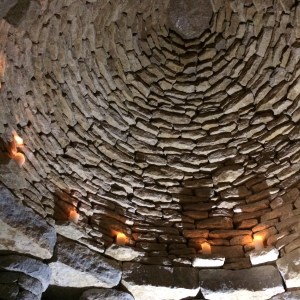
    Beneath a smudged sky of watercolour greys in Cambridgeshire, southern England, Toby Angel walks down a muddy autumnal track, Nash, his faithful Labrador, at his ankle. Mr Angel likes the short, meandering path from the car park to Willow Row, the first round barrow to be built in Britain for 3,500 years, slowly emerging from the surrounding willow, ash and oak trees (pictured above and below). Like many visitors, he appreciates the physical exertion that, however slight, shakes off the yoke of modern comforts. Humanity has long regarded the circle as a fundamental and venerable shape: a newborn infant focuses almost immediately on the mother’s breast and iris; the ancient Greeks saw in circles the divine symmetry of nature. Neolithic burial chambers were community focal points. Human ashes have been found alongside evidence of feasting and animal bones; a favoured companion perhaps, an earlier Nash?
    IMG_0485

    Mr Angel set up his company, Sacred Stones, after he had been disappointed by the crematorium experience following his aunt’s death. “Nasty blue carpet, Luther Vandross and twenty minutes later we were out,” he remembers. “Families relinquish control of death to the commercial devil that is a box-ticking and prescribed process”.

    IMG_0486

    A six-foot, roughly diamond-shaped, sentinel stone welcomes visitors, standing at a gap in the trees. The female stone (all such stones are sexed, with obvious phallic shapes denoting masculinity) breaks the sight line and introduces the softly domed barrow behind. Two muddy shoulders, slowly grassing over, reach forward almost to the stone and describe a small oval entranceway.

    IMG_0484

    Stepping inside the transformation is immediate. A few paces and the world outside is another place. Sound reduces to a low, comforting hum as the wind channels through the barrow. Voices do not carry and are instead softened by the floor and stone walls varying in hue from grey to blue depending how deep in the mine they had lain (the higher the pressure, the more a stone exhibits a blue colour). The 11-metre wide structure consists of an inner chamber of 59 large ‘family’ niches surrounded by an outer circle of 349 smaller spaces. Both the inner and outer sections have corbelled roofs five meters high. The stones are supported by their collaborative weight, with a modest use of lime mortar throughout. York stone benches lining the outer circle and inner chamber offer a place for contemplation, laughter, grieving; whatever the family want, and whatever offers them a “simple, easy and uncluttered death”. Prehistoric barrows harnessed the excitement and energy of a communal human gathering as our forebears celebrated where we came from, as well as where we were going. The ceremony, as the central unifying event, connected the living to the dead. It still can.

  • cowManufactured anger can be just as dangerous as the real thing
    Like the captain of a sinking ship appealing for calm at the lifeboats, Rabbi Lionel Rosenfeld tried in vain to impose order on the Kiddush; the meal celebrating the Jewish Sabbath. “Families first, families first!” he exhorted over the herring. He was either unheard or ignored: elbows were deployed with the speed of the tanks he had fought in during the 1982 war in Lebanon, children squeezed between ample bellies to snaffle crisps and the single malt was knocked over into the aubergine. The semi-organised chaos of the Western Marble Arch synagogue in central London contrasted with the peace of the Nirvana restaurant next door.

    The animated and wiry rabbi blesses every day he is able to perform this duty. Three years ago he was warned by MI5 that, alongside Boris Johnson, the-then Mayor of London, his name was on a Hamas hit-list; “exalted company,” he smiles. Shabbat, Judaism’s Sabbath, the weekly day of rest and centerpiece of Jewish life, is always a special time for the faithful. The weekend of November 11th and 12th was especially significant. Hoping to promote community and identity by energising those whose participation had waned a tad, Ephraim Mirvis, Britain’s Chief Rabbi, had decreed it to be ‘Shabbat UK 2016’; the third annual jamboree of all things Jewish.

    But as one community was united in celebration, so too was another in condemnation. Shabbat starts just before sunset each Friday, after which all work is to cease until Saturday night. In winter months this sees observant Jews knocking off around four o’clock in the afternoon; the Chief Rabbi hoped employers would respect this requirement. Most respondents shrugged in bemusement (it is not unusual to see Britain’s pubs heaving at this time on a Friday, regardless of season), but some expressed outrage at a perceived shoehorning of religion into the secular British workplace. The Chief Rabbi would be better to keep his nose out of such matters, they carped.

    How confected is such peevishness? Britons consider themselves an undemonstrative and tolerant bunch who live and let live, mustn’t grumble and rub along well enough, thankyou very much. They wish not to offend, or be offended, in almost equal measure, but can’t remember which is more important. This ability to muddle through and accommodate disagreeable attitudes has served the country well and it is unusual for otherwise inconsequential issues to beget such chippiness. Ruddy cheeks are generally assumed to be the result of bracing walks and fireside whiskies, not grousing over largely irrelevant social mores.

    Even the Labour party has had to exorcise the ghost of anti-Semitism, and the line between criticising Israeli government policy and Jews more generally is easily smudged. It is easy to see why, says James Sorene, CEO of the British Israel Communications and Research Centre (BICOM), a think tank. He blames a lazy and complicit press for whipping up old prejudices. The complicated subject of Israel “makes good journalists better,” he believes, “and bad journalists worse”. One in five Britons think hating Israel and questioning its right to exist is not anti-Semitic says a BICOM poll released on November 4th.

    Islam has suffered superfluous rage too. Louis Smith, Britain’s four-Olympic-medal winning gymnast, took a tumble recently after he appeared to mock the religion in a leaked video. His drunken antics resulted in a two-month ban from his sport’s governing body. It will not impact his career, but sends a dubious message. Did British Gymnastics get on its high horse because he insulted Islam or for being a ninny? (If the latter is now their responsibility, public bodies will be busy; not least in the Palace of Westminster.) Incitement to hatred is a criminal act; laughing at others’ religious beliefs is not and dictating what can and cannot be considered funny ultimately leads to the Charlie Hebdo attack. Concocted fury born of a fear of upsetting religious sensibilities helps nobody.

    The worrying aspect of this trend for fabricated anger and knee-jerk rage is that it stifles productive debate – the one thing Britain is crying out for in this topsy-turvy 2016. Ridicule is a powerful de-motivator and who wants to offer opinions and receive a tongue-lashing in return? Social media hurl voices much further than they hitherto have reached and they land with added force; moderate views have consequently retreated from public discourse. Increasingly, the only views available are polarised. The majority of participants care little for tackling or winning the argument; the primary purpose is to vent spleen.

    Reasons to be cheerless

    Gisela Stuart, MP for Birmingham Edgbaston and Chair of Vote Leave for the EU referendum (now Chair of its successor: Change Britain), identifies three culprits for this coarsening of political discourse in recent years. First: the professionalisation of the politics of outrage. Epitomised by the “bloody scary” former Austrian politician Stefan Petzner, the trick is to play the underdog, capture headlines and be as shocking as possible, without letting public outrage turn to disgust. Second: the unhealthy manner by which political parties have courted race and religion. Distributing Eid cards for example, or targeting specific ethnicities might be considered vote-winners, but can backfire and highlight division. Third: the tribal nature of British politics, particularly since the Brexit vote. In Britain, winners are expected to demonstrate high-minded responsibility, losers to huddle together and seek solace. Brexit cut across these lines: Theresa May supported Remain but finds herself having to champion Leave. “And the losers are saying ‘how dare you win! Explain yourselves!” Mrs Stuart laughs, “actual ideas have gone out the window”.

    When discussion becomes antipodal and mouths and minds open and close in toxic ying-yang relationships, society risks fracturing. Rabbi Rosenfeld remains hopeful and considers Britain a wonderful place to practice his religion. He longs for a return of traditional British balance. “After all,” he grins, “as Shimon Peres said: it is only anti-Semitic to hate Jews more than absolutely necessary.”


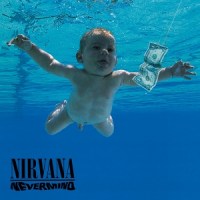
  • nirvananevermindalbumcoverTobi Vail, former girlfriend of Nirvana front man Kurt Cobain, became a fan of the youth-targeted deodorant Teen Spirit when it was launched in America in 1991. As a joke Katherine Hanna, the lead singer of the band Bikini Kill, which also included Vail, scrawled across a wall in Cobain’s apartment ‘Kurt smells like teen spirit’.
    Misinterpreting the statement as a comment on mainstream American society at the time, Cobain decided it was the perfect phrase to embody the disconnected rage and contempt felt by those who had not benefitted from, or could associate with, the excess and misplaced optimism of the indulgent 1980s. He used it for a song he had written which included lyrics like ‘I feel stupid and contagious’ just so there was no doubt where he was coming from. He called it ‘Smells like teen spirit’ and it was released on Nirvana’s second album, Nevermind, which came out 25 years ago on September 24th 1991.

    The album went Platinum by November and reached Diamond status in 1999 with 10 million units sold. Only the most ardent of fans would claim it was musically one of the greatest albums of all time, but sick of the cartoonish excess of the ‘hair bands’, stadium-rock and spandex of the previous decades, Nevermind spoke to a generation like nothing else had. Cobain once explained where he drew some of his inspiration for the dark feelings and rejection he channeled in his lyrics: “Some of my very personal experiences, like breaking up with girlfriends and having bad relationships, feeling that death void that the person in the song is feeling — very lonely, sick”.

    If there is any doubt about how important Nevermind was, consider this: nothing quite so powerful, with the ability to resonate within a generation has come along since. In terms of economic stagnation and career aspirations, many people today who feel globalisation has let them down are channeling the same anger and frustration experienced by the fraternity Nirvana appealed to 25 years ago. But there has been no voice or sound with the same impact on the current generation as Nirvana had back then. Bruce Springsteen is still valiantly carrying the torch, but nothing and nobody has exploded into the public consciousness with the force to define a genre like Nirvana did with Grunge.

    So it’s all the more surprising then, that the title of the album was Nevermind, which suggests more of a shoulder-shrugged disappointment than an angst-fuelled middle-digit to the world.

    And it got me thinking. What, 25 years ago, had you hoped to achieve by today that you have not – but no major regrets, just something that you might shrug off with a “well, never mind”? I decided to spend a night out in London asking friends and strangers alike and include some of the answers below:


    I wanted an ability to drink multiple pints, or wines, without succumbing to feelings of remorse and regret the following day.

    I was a stoner. I wanted to be Jim Morrison.

     I wanted to walk and stop wearing nappies (an odd response given the question)

     I wanted to be able to talk to women without going red.

     I wanted kids and a white picket fence. My furry four-legged friend, though, is cheaper and will die younger!

     I was 18 and had just won the North of Scotland Junior Best All rounder (a cycling competition) and come 6th in Scotland. I was pretty certain I would win an individual Scottish championship.

     I was 15. My major aim to was to go out with Johnny Ray. I wasn’t cool enough and two years younger so….never mind. 

     I wanted to have a physique like my brothers when he was about 17.

     I wanted to sleep with one of the Spice Girls.

     I didn’t save enough money before my gap year travels. Not having enough money was the least of my worries as it turned out, so never mind.

     Sad though it is to say, if I think back to listening to that album endlessly on flying scholarship and being best student of the year with a mate who went onto fly harriers, the answer is probably fast jet pilot.

     I was gonna be a big shot architect. No joke.

     I was incapable of linear thought back then aged 19. I always assumed I would want a Ferrari or Lamborghini. Turns out I don’t.

     Honestly: climb Everest (failed); play pro-rugby (failed); learn to paint (failed very badly); live and work in a really rough foreign place (failed – sort of).


    Taking my research ever more seriously as the night wore on I had a strained conversation (as I could barely be heard) in a bar at 2am. Starting poorly by asking the woman I was chatting to/shouting at if she was from Denmark having heard her accent, she said, no, Isle of Lewis, Scotland. I plowed on regardless and posed my question. She wasn’t sure she’d heard of Kurt Cobain. “What?”, I exclaimed, possibly a little too forcefully, “the restless, troubled genius that gave a voice to millions and defined an era; the sincere, contemplative, creative force that was so genuinely authentic he really felt the pain he wrote about such that it eventually killed him?”

    “Sorry, I don’t know who you’re talking about”

    “But, he was…….oh, never mind.”

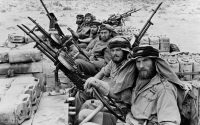
  • lrdg imageEdwin Weaver was probably born in 1908; we can’t be sure as it is suspected he falsified his age to enlist in the Royal Artillery in Birmingham in 1925. He volunteered for the SAS in 1943 and, after evacuating escaped POWs along the Italian coast for many months he parachuted into eastern France in August 1944 on Operation LOYTON. He was captured, along with the rest of his SAS patrol, on October 7th of that year.

    On October 15th he and seven comrades were driven to a spot in a forest just to the west of the hamlet of La Grande Fosse. The first off the truck was Reg Church. He was stripped naked and made to stand in front of a ready dug grave. SS Unterscharführer Georg Zahringer told the subsequent war crimes tribunal at the British Military Court at Wuppertal, Germany, in May 1946 what happened next.

    Wuttke was carrying a Walther pistol and Gaede also had a weapon with him. Practically                      immediately I heard a shot. The remaining English prisoners in the truck did not say anything but remained silent. The next prisoner was made to jump down and undress like the other and was taken away to the same place. Again I heard a shot. This went from one prisoner to another until it was the turn of the last.

    The last man out of the truck was Edwin Weaver. Georg Zahringer told how he watched as Weaver was led to the edge of the grave. He was not trembling. He then turned to one of the Germans and said something, before he was shot through the back of the head by Wuttke. Weaver’s was the last body to be exhumed from the grave and was found draped over his friends.

    As the Germans drove away from the crime scene Zahringer described a solemn atmosphere in the truck. He asked Schossig, the man Weaver had spoken to and the only one who could speak English, what he had said. Schossig replied, ‘We were good men’.

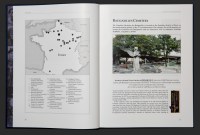
    SAS_ROH_BoxsetThis story and 373 others have just been commemorated in a three-volume work; The SAS and LRDG Roll of Honour 1941-1947. It is the culmination of one man’s work to explain the deaths of all the SAS and Long Range Desert Group (LRDG – the forerunner of the SAS) fatalities of the Second World War. (The last man died in 1947 having never left military hospital, but as the SAS was disbanded in 1945 he was never officially listed as being a casualty of the regiment.)
    The project was carried out by an anonymous author, and friend of mine, who calls himself ex-Lance Corporal X for anonymity. It cost him £58,000 of his own money. He was driven to start what turned out to be a 13-year quest after being asked to leave wreaths in Algeria for SAS men killed there in 1944. Trouble was, the fighting had finished at least a year before. So what were they doing there?

    Dunno, said the SAS Association. Odd, thought ex-LCpl X, I’d better find out. It became a passion and consumed all the spare time his very understanding family had. He contacted all the next of kin and trawled the national archives and regimental histories. Slowly, over many years of correspondence and interviews, the families came to trust him and believe in the integrity and dignity he promised to bring to the project and the memories of their loved ones.

    He travelled the world (including to New Zealand to speak to the family of Francis ‘Frankie’ Rhodes, a member of the North Auckland Mounted Rifles and later the LRDG, killed in an accident whilst on leave in November 1943) and insisted on adding colour and depth to the men’s stories, rather than just recounting the ‘who’ and ‘when’ of the casualties.

    The locations for many of the deaths have hitherto not been recorded, or have been done so inaccurately. Ex-LCpl X will use any profits from his project to construct fitting and permanent memorials to those that currently have none. Anything left over will go to the military charity Combat Stress.

    The author has eschewed a boys-own approach; bullets don’t fly like angry wasps and not even the biggest guns spit hot death. The material is harrowing stuff. Hitler’s Kommandobefehl, or Commando Order, of October 1942 formed the illegitimate justification for the murder of Allied troops captured behind German lines. Having been wounded in action, John Reginald “Reggie’ Williams, Sam Pascoe and Joe Ogg were taken from the Hotel Dieu Hospital in Poitiers, France, and murdered, most likely by lethal injection, by Hauptmann Dr Georg Hesterberg. The bodies were disposed of secretly.

    SAS_ROH SPREAD_1I have been very happy to help ex-LCpl X promote the project. The Telegraph reported the launch of the work and followed it up with another article. The story has also been across the UK commercial radio network. It is an incredible achievement and will be of immense value to historians and future researchers as it is the first time anyone has pulled together all the records and included the next of kin. 13 hitherto unrecognised members of the SAS and LRDG were discovered in the course of the author’s research. I commend the work to you; it is £60 very well spent. More information can be found at the project’s website (www.sas-lrdg-roh.com) or on twitter @SAS_LRDG_ROH.

    Edwin Weaver’s grave (with no inscription) lies in the Durnbach war cemetery, 15km east of Bad Tolz, in Germany. He is also commemorated on the war memorial at St James church, Shirley, Solihull and on the Stele de Prayé memorial above Moussey in France.

  • tweet image25 years ago today Gerald Ratner, Chairman and Chief Executive of his family jewellery firm, made his now infamous speech in the Albert Hall in London. Speaking at a conference of the Institute of Directors to a group of 5000 business leaders, he mused on the reasons for his impressive record. As he had taken over the company in 1984 and grown it from 150 stores to over 2000 with annual sales of £1.2 billion, he had a captive audience, eager to hear the secret of his success. “We do cut-glass sherry decanters complete with six glasses on a silver-plated tray that your butler can serve you drinks on, all for £4.95,” he told the audience. “People say, ‘How can you sell this for such a low price?’ I say, because it’s total crap. ”

    Cue a meltdown in the share price, not helped by his further asserting that earrings in his stores were “cheaper than an M&S prawn sandwich, but probably wouldn’t last as long”.
    £500 million was wiped off the value of the company and within 18 months Ratner was out of a job. Worse was to come. “I spent seven years lying on the bed watching Countdown” he later admitted. Surely a lesson for entrepreneurs everywhere of the hellish consequences of such hubris.

    In the quarter of a century that has passed since Ratner’s speech there have been many examples of otherwise stable and functioning businesses getting it so so wrong when it came to, arguably, their most important asset: their reputation. Take BP’s handling of the Deep Water Horizon oil rig disaster. An explosion on 20 April 2010 killed 11 people, sank the rig and pumped oil into the Gulf of Mexico for 87 days. The US government reckons the total spill was 4.9 million barrels of oil. BP estimates its total spill-related expenses at $37 billion.

    At the height of the crisis response, BP’s Chief Executive, Tony Hayward, said “There’s no one who wants this over more than I do. I would like my life back“. After 11 deaths, such a crass comment seemed to exemplify BP’s mishandling of the crisis and general incompetence. The company nearly went bust.

    Who advises these people? Or, if you’re worth a few million quid and believe your own press, do you start to think you know how to conduct your own reputation management? A head for figures and business models counts for nothing if there is not also an instinctive, antennae-twitching affinity with how fragile a reputation is.

    Through the lens of social media that potential downside can be multiplied by a considerable degree. Too many companies think they can outsource their communication or reputation strategy. In February this year, as I’m sure you’ll remember, Kanye West released his new album and went online to rate it, ahem, ’30 out of 10′. In response, the official Twitter feed of Virgin Australia tweeted ‘@kanyewest EAD you douche’. Without translating the niceties of the message, take it from me this did not equate to ‘ Dear Mr West, bravo on the new album and we heartily agree with your objective assessment’.

    It was taken down after 60 seconds, but the damage was done. Virgin Australia had to apologise, backtrack at some pace and try to repair a tarnished reputation. What’s worse: that Virgin Australia entrusted (or sub-contracted) their voice to an individual who thinks language like that is acceptable, or that the senior leadership of the company cared so little for their output they delegated or outsourced the task in the first place ?

    After a crisis a company needs to be communicating (and Twitter will be inked into the team sheet for this task) immediately: minute five, minute 10, minute 30, and so on. There isn’t time to contact the CEO for cleared copy or lines-to-take. The individual empowered to press send on the tweet or chair a press conference needs to be in the mind of the Board and sufficiently grounded not to derail a response before its even up and running.

    The Ratner Effect, as it became known, nearly destroyed the jewellery company. The same thing happened to BP. It will keep happening as long as Board members think PR-spin or a bluff, head-in-the-sand approach are effective reputation strategies. Happy anniversary Gerald.