• mars and venusTHAT men and women think differently is now widely accepted. Why they do so is another matter. One possible explanation is that in the time of hunting and gathering different skills were required: men spent time away from camp, tracking animals and fighting off intruders, and women needed social skills to bring up children. Yet there are bound to be many other factors at work for this variation to survive into modern times. The latest research suggests that living standards and access to education probably bear more responsibility for cognitive disparity between men and women than genes, nursery colours or the ability to catch a ball.

    Previous studies have shown that male and female brains are wired differently. Last year Ragini Verma of the University of Pennsylvania used sophisticated imaging techniques to show variations between men and women in dominant connections in the cerebrum, the part of the brain that does the thinking. Dr Verma speculated this could help explain why women tend to have better memories, social adeptness and an improved ability to multitask.

    Now Daniela Weber of the International Institute for Applied Systems Analysis in Vienna, and her colleagues, suggest why such changes come about and, importantly, how the differences can change. The group’s analysis, reported this week in Proceedings of the National Academy of Sciences, finds that the cognitive performance of women—much more so than men—benefits from factors such as greater employment opportunities, increased economic prosperity and better health.

    A case of misremembering
    Ms Weber and her colleagues based their work on interviews with 17,000 men and 14,000 women carried out by an initiative called the Survey of Health, Ageing and Retirement in Europe, conducted in 2006-07. The interviewees, aged 50 to 84, lived in 13 European countries and were subjected to three tests for cognitive performance. They were grouped into three geographic regions: northern Europe, central Europe and southern Europe .

    For each country a regional development index (RDI) was adopted, an amalgam of GDP, family size, infant mortality, life expectancy and national education levels. These criteria were selected to represent a country’s educational and living standards for the birth years of the interviewees, and then compared with participants’ cognitive performance.

    That performance was determined using tests for episodic memory (the retention of words in memory), category fluency (naming examples of, say, animals) and numeracy. Women are expected to outperform men in episodic memory and men do better in numeracy. Neither sex is thought dominant in category fluency.

    Episodic memory matters because it is linked to emotion. The brain remembers unconnected words by linking them to a memory or imagined situation. It is the emotion of the memory that supposedly helps the brain remember the word. Whether women actually are more empathetic than men is debatable. It may be that society has expected such capacity from the principal child-carers for so long that it has become ingrained. The same goes for numeracy. Is science dominated by men because they are better at it, or because it was a career choice not widely open to women before the late 20th century?

    The new study does not seek to answer these questions. But it pushes research further towards answers. As expected, in episodic-memory tests women outperformed or were equal to men in every geographic area and across almost all age groups. The results for numeracy were even starker. Men outperformed women in all areas and in all age groups. The differences in category fluency were so slight as to be statistically irrelevant. But the really startling discovery was how the results changed over time and by region.

    As countries improved in RDI terms, the cognitive performance of the whole population was raised. Northern Europe rated highest across all age groups, followed by central and southern Europe. Unexpectedly, the study found that the better developed a country, the higher the rate of increase in women’s cognitive abilities.

    Quite why women benefit disproportionately from societal improvements is not known. They may be starting from a more disadvantaged level, with greater potential to catch up as the RDI score improves. Generally, the cognitive differences in numeracy between men and women are narrowing, more so in northern Europe than in southern Europe. North European women aged 50-54 are also increasing their lead over men in episodic memory, by remembering almost one more word out of ten, says Ms Weber.

    Whatever the reason, this study indicates that cognitive differences between men and women are not solely inherited. It suggests that, to a degree hitherto unacknowledged, they are learned from the roles a society expects males and females to perform, and that those differences can change as society changes. Modern times require modern thinking.

    This article was published in The Economist on 2nd August 2014.  See this link.
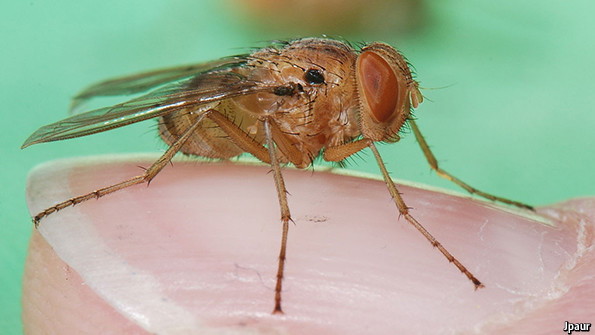
  • flyDINNER parties can be tiresome ordeals, particularly if you find yourself next to an individual keen to show off worldly credentials, such as a journalist. But they can be even more trying for the hard-of-hearing. Modern hearing aids are capable and discreet. Where they are left wanting, however, is in reducing the background hubbub and focusing on the many supposedly interesting stories from your companion. But that could change if results from the University of Texas, described in the journal Applied Physics Letters, can find their way into a commercial product.

    The researchers’ subject was a tiny species of fly called Ormia ochracea. A native of the south-eastern United States and Central America, this fly is famed for the pinpoint accuracy of its hearing. Mammalian brains such as our own calculate where a sound is coming from based on the tiny difference in its arrival time at each ear. For many insects, however, this approach does not work. Sound waves are longer than the insects’ bodies, so the minuscule difference in arrival time cannot be discerned.

    Yet O. ochracea can spot the direction of the chirp from a male cricket—its preferred prey—even though its hearing mechanism is a mere 1.5 millimetres across. And what a mechanism it is. A tiny structure similar to a playground see-saw connects the fly’s two sound sensors, and vibration on one side drives the other in the opposite direction. The net motion of the see-saw permits the fly to determine what is known as the “phase” of the sound wave—in other words, the extent to which the peaks and troughs of the sound waves detected by its sound sensors line up with each other. This allows for fantastically precise determination of its direction of origin.

    Michael Kuntzman and Neal Hall, of the University of Texas at Austin, set out to replicate this ingenious structure in silicon using a flexible beam surrounded by piezoelectric materials. These turn movement into electricity, and vice versa. The East Japan Railway Company, for example, has installed such devices in floor pads at a Tokyo station to generate power from movement of commuters during the rush hour. But this is the first time these materials have been applied to technological mimicry of O. ochracea.

    It could result in a new generation of hearing aids that are no bigger, but are much better. Using an artificial version of the fly’s direction-finding technique, they could be designed to focus only on those sounds or conversations that are of interest to the wearer. That would make dinner-party conversations less of a chore—though there is, alas, no technological solution to the problem of a tedious dining companion.

    This article was published in The Economist on 25th July 2014.  See this link.

  • mustard plantOF ALL the nasty ways people have devised to harm each other, chemical weapons are among the worst. But even they have varying levels of unpleasantness. Mustard gas blisters the skin and lungs but is an inefficient way of killing. Nerve agents such as sarin, soman and VX are much more deadly. These can linger for days, and only tiny amounts are needed to cause uncontrollable muscle spasms. Death by suffocation follows swiftly as the victim’s diaphragm stops working properly, and he cannot breathe.

    In a world where the use of chemical weapons is supposed to be prohibited, finding out when and where they have been deployed is important. But that is not as easy as it sounds. Though nerve agents hang around long enough to be formidable weapons, they degrade in the presence of moisture into chemicals called alkyl methylphosphonic acids. These are reliable signals something bad has happened but they, in turn, break down into simple molecules that leave no clear signature of the original poison.

    The result is that, within a month or two of an attack, concentrations of alkyl methylphosphonic acids left in the soil are too low for gas chromatography—the tool normally used to search for traces of nerve gas—to detect. What is needed is a way to concentrate the chemical signal. And a group of researchers from the University of Central Lancashire, in Britain, and the country’s Defence Science and Technology Laboratory, led by Matthew Baker, think they have one: the humble white mustard plant.

    White mustard (named after the colour of its seeds, not its flowers) grows rapidly in many sorts of soils. That makes it suitable for deployment all over the world. The researchers’ crucial discovery, though, was that if the soil in which it is growing contains a nerve agent (they used VX) the plant will absorb it, metabolise it into alkyl methylphosphonic acids, and store those acids in its tissue. It will do so even when the agent’s level in the soil is too low for chromatography to detect the poison directly. The plant’s constant extraction of chemicals from the soil means the acids build up in it to a point where detection is possible. Regardless of soil type, Dr Baker found, evidence for the presence of VX could be extracted from plants at least 45 days after application. Bad guys beware.

    This article was published in The Economist on July 19th 2014.  See this link.

  • Syria chemical weapons, Ark FuturaHIGH pressure in the North Atlantic in recent days has enabled the smooth passage of the Ark Futura, a Danish vessel, from Syria to Britain. The stable conditions are helpful, as the Ark Futura is carrying the worst of the remaining Syrian chemical weapons arsenal. The task of decommissioning Syria’s weapons programme has gathered speed since the Organisation for the Prohibition of Chemical Weapons (OPCW), the international body responsible for implementing the Chemical Weapons Convention, was allowed access to the Syrian arsenal last year. Much of what remains of Bashar Assad’s deadly armoury is due to dock in Southampton on July 15th.

    Following a chemical attack on the civilian area of Ghouta on August 21st 2013, Mr Assad complied with international calls for the destruction of his chemical weapon programme. The OPCW announced in June that all identifiable agents and precursor chemicals had been removed from the country. The most potent materials were transferred to the Cape Ray, an American ship, for destruction in the Mediterranean Sea, and the Ark Futura for destruction in Britain. The less potent but still thoroughly unpleasant remainder will be destroyed in Finland and America over the coming months.

    The development of chemical weapons was perhaps science’s poorest contribution to humanity. Toxic chemicals have been used as weapons throughout history, but the wars of the 20th century must bear most of the blame. It is fitting, then, that primary responsibility for the destruction of Syria’s arsenal has been borne by America, Britain and Germany (which will be disposing of the leftover chemical sludge after the Cape Ray has finished her work). The load expected in Southampton consists of 150 tonnes of precursor chemicals for VX, a nerve agent, as well as 50 tonnes of hydrogen chloride and hydrogen fluoride. Thankfully, no weapon can be made from mixing these materials alone. But you still wouldn’t want this stuff on your high street, courtesy of a terrorist attack. Hence the involvement of the British armed forces, which will be destroying the cargo through a standing contract with Veolia, a utility-management company.

    It is getting harder for people such as Mr Assad to use chemical weapons with impunity. Advances in science mean that detection and attribution of such attacks are becoming easier. But with many precursor materials having legitimate civilian uses, and with little time needed for factories to switch from making legitimate products to weapons, the real challenge for the authorities is determining in advance who plans to misuse the precursors in question. There is, as yet, no answer to that conundrum. But by helping to destroy these grotesque weapons, science has gone some way to redeeming its earlier activities.

    This article was published in The Economist on July 14th 2014.  See this link.