• The attacks in Paris on Charlie Hebdo and a kosher supermarket reignited the debate about freedom of speech and tolerance for the beliefs of others.  One issue that received less attention is how far an open society should surrender freedoms it values highly in the name of security.

    An illuminating exchange took place on BBC Radio 4’s Today programme on 13th January between presenter Justin Webb and the UK’s Deputy Prime Minister, Nick Clegg.  It showed that even at the highest level of government there is a reluctance to offer the public clear views about how to tackle terrorism in the modern world. Part of being a leader involves clarifying complex issues so that the public can understand better the choices they are asked to make.

    Mr Clegg refused to answer whether he thinks some conversations on social media should be inaccessible to the security agencies for ever.  Vacillating on this crucial point and providing opaque explanations elsewhere, he did not engender a strong sense that he understood many in society are confused, worried and seeking leadership.  His reluctance to hold and defend a clear position also implied the government has not debated this issue at length and that confident and considered, albeit conflicting, positions had been taken.

    It’s a long post (unedited to provide the overall context) but stick with it; this affects us all. The momentum in the war of ideas currently lies with those that wish us harm.

    Justin Webb: Are you happy being in a position of disagreement not just with the Prime Minister but with the head of MI5 as well? The head of MI5 saying recently in his speech his sharpest concern, as he put it, is the gap between the challenging threat and the growing availability of capabilities to address it.

    Nick Clegg: So just to be very clear, actually I met the head of MI5 yesterday and I’ve obviously spoken to him and the head of the agencies on numerous occasions.  The problem they’ve identified, which is a very real one and one we are acting on, is how to access data, how to, if necessary, on the back of a warrant from the Foreign Secretary or the Home Secretary, intrude on the communications between people who mean to do us harm, even where those communications originate from overseas or foreign internet service providers or communication service providers. That is the thing that the agencies have identified as being the biggest problem. That, by the way, is why we legislated, with my active support earlier in the summer, emergency or fast-track legislation, to kind of fill that gap because there was a problem that, as they put it, a lot of that communication would go dark if we didn’t have access to that data.

    JW: But he’s [Andrew Parker – the head of MI5, the UK’s domestic spying agency] still worried about it going dark, without that, in the future and without necessarily that bill. Now, are you comfortable, or did he say to you that he is comfortable with your position on a lack of activity…

    NC: Well let’s be clear. The one component of the various measures that have been floated that I have objected to, the so-called snooper’s charter, would do absolutely nothing to deal with this issue of how we, as a country, have access to data which originates overseas but which might relate to people who want to do us harm, because let’s remember what the snooper’s charter was about, was about storing the social media activity and the web sites visited by every single man, woman and child in this country; by everyone, and, by the way, by millions and millions of people, so that’s huge amounts of data…

    JW: But not accessing it without a warrant.

    NC: No, no, no, but it was about, exactly, but it doesn’t deal with the issue which we are having to grapple with, which is how, for instance, to make sure that your mobile, tablet or your phone is properly related to an IP address, just like your mobile phone is related to a telephone number, which, by the way, is another thing that we have acted on, in fact we’re legislating on as we speak right now. The point I make is that, you know, sometimes people sort of think if we pass the snooper’s charter everyone will be utterly safe and if you don’t pass it everybody utterly unsafe. It isn’t like that.

    JW: But that’s not the point Andrew Parker is making.

    NC: You have to make a judgment, don’t you, about the balance between security and liberty and the workability of these proposals.

    JW: Can I just get this straight. What you are saying is there should be circumstances where people can have entirely private conversations via social media on the internet, that are inaccessible for ever to the security services. That is what you think is important.

    NC: No, this has, this is where the great confusion lies, this has nothing to do with, as your question has implied, this has nothing to do with our right, which, of course, we should retain, as a state we always retain the right to steam open envelopes, to listen to telephone conversations…

    JW: But that’s what Andrew Parker is saying he can’t do in the future.

    NC: As I’m saying, a snooper’s charter is not the answer to that. The snooper’s charter, let’s be very clear, or what was dubbed the snooper’s charter, was one component among several measures, most of which we have acted on in whole or part, let’s repeat because it’s very important this, because I think it does cross a line in my view, it is not a proportionate response to that particular problem and, by the way, many experts say it’s not a particularly workable proposition either. What it would do is it would say that you, every single person listening to this programme now, every website they visit over the last year, every social media interaction they have will be stored by somebody. That doesn’t deal with the issue of how we make sure that when people mean to do us harm, which was the subject, quite rightly, of what the Prime Minister was talking about yesterday, we could retain the ability…

    JW: But are you saying it shouldn’t be stored? That’s the point, isn’t it, that there should be some areas that are properly dark forever?

    NC: It’s not about dark. It’s about do I think that scooping up vast amounts of information on millions of people, children, grand mothers, grand parents, elderly people who are doing nothing more offensive than visiting garden centre web sites, do I think that is a sensible use of our resources and our time, and does it address the issue which you, quite rightly, identify, the agency, quite rightly identify, which is as technology mutates, as this globalized industry becomes more and more global, how do we make sure that we continue to have the reach into those dark spaces so that terrorists cannot hide from us.

    JW: But are you saying we should be able to or we shouldn’t be able to? I’m not understanding from you whether you accept, which some civil libertarians say, we absolutely should have the ability to communicate with each other in a way that is inaccessible, or, as Andrew Parker and others say, no we shouldn’t.

    NC: With respect you’re confusing the right that the state has, always has done and should retain…

    JW: No, I’m not talking about a right, I’m talking about the practical possibilities of doing it and what Andrew Parker wants is to be given, he thinks he does have the practical possibilities to do it, he wants to be given the right to do it.

    NC: Right, let me explain again. The problem of what Andrew Parker calls things going dark, is because so much of the industry on which we depend for communications, particularly modern communications, aren’t located in this country. They are servers on the other side of the planet. They are internet service providers based in California. And the absolute heart of this issue is how do we, given that we can only have jurisdiction over our own affairs in Great Britain, make sure that we work well with those internet service providers so that they give us access to information where that helps to keep us safe. And we’ve done a number of things as I said, we’re actually legislating right now under the new terrorism bill to do that.

    JW: I’m still not clear about whether you accept that people should be able to communicate in total privacy or not, just yes or no, should they be or should they not?

    NC: Right, the snooper’s charter was nothing to do with…

    JW: No, should they be or should they not? Never mind about the snooper’s charter.

    NC: Privacy is a qualified right. If someone wants to do us harm we should be able to break their privacy and go after their communications…if you just let me finish the sentence I’ll explain to you why I think you’ve got this confused. The snooper’s charter wasn’t about intercepting communications it was about storing a record of all your social media activity of every website you’ve visited, and here’s the key thing: of every single individual in this country. Of people who would never dream of doing anyone else any harm, who would never dream of becoming a terrorist or even have anything to do with extremist ideologies. So the question we need to ask ourselves, in a free, open society as we defend our values against the abhorrent attacks we saw in Paris, is where do you draw the line? Look, I’ll give you an example. If you want to we could make ourselves a lot safer in this great city of London by imposing a curfew so no-one can leave the house after 9 o’clock. We don’t do that because that would be offensive to our values as a free and open society…[talked over by JW below}

    JW: So, one of those values is that we can have conversations in total privacy?

    NC: ..and what I’m saying is you strike the right balance, you take the actions to keep us physically safer through the fast-track legislation that we’re already proceeding with, but at the same time you valiantly defend and you are vigilant about things which might encroach on the basic freedom for people to go about their everyday business, particularly if they’re innocent of any wrong-doing whatsoever.
  • Mohammad_Mehdi_Al_BayatiAs introductions go, Mohammed Mahdi al-Bayati’s takes some beating.  Described by his media consultant as “the person with the worst job in global politics”, Iraq’s minister for human rights carries his burden with grace.  Mr Bayati, 52, an ethnic Turkmen, is a former foe of Saddam Hussein and still carries the physical scars of his efforts.  The moral compass employed by many western societies who view decisions in black and white terms does not work for Mr Bayati.  By necessity he inhabits a morally-grey world, wrestling daily with choices the likes of which will trouble mercifully few of us in our lifetimes.

    Take for example what he describes as the most shocking moment of his time in office.  He talks of a 13-year-old Yazidi girl whose seven family members had been killed by the Islamic State of Iraq and the Levant (ISIL, now commonly called Islamic State, or IS).  Kidnapped and repeatedly raped she was sold for $4000 US at a people-trafficking market held weekly in ISIL-controlled Mosul, Iraq’s second city.  Through his office Mr Bayati supported the girl’s purchase and continues to endorse the purchase of of other women and girls.  Does that encourage the kidnappers? “If you don’t buy for release,” he suggests, “they will be slaves.”  In the absence of a military or (highly unlikely) political solution to the problem of ISIL, moral pragmatism such as this has to suffice.

    Or take his attitude towards the use of shia militias. These volunteers, as Mr Bayati prefers to call them, are critical to Baghdad’s fight against ISIL. But there are inevitable problems. They have been widely blamed for abuses and for the inflammation of the sectarian tensions that pushed the sunni community to support ISIL in the first place.  The Iraqi military is able to exert only tenuous control. “They are not necessarily well-trained, and yes, they will make mistakes,” Mr Bayati says.  “But if they are not used, then ISIL will control the whole of Iraq.”

    The use of the death penalty, reinstated in 2004, is another controversial area. A recent United Nations report said that death sentences have been passed based on evidence from disputed confessions or secret informants, and that some defendants saw a defence attorney for the first time only when they arrived in court.  The Iraqi government says it is unfair to expect the same standards of due process from a country that is, effectively, in a state of civil war. It is also, Mr Bayati says, a deterrent to any foreign fighters heading to Iraq: “If they hear the news that we have stopped the death penalty, the whole world will come to Iraq to fight,” he said. Furthermore, when asked about an amnesty for ISIL fighters on death row Mr Bayati is uncompromising, perhaps because he has a domestic audience to consider: “How about an amnesty for all those already put in their graves by terrorists?” he said. “There are thousands of orphans, and many MPs and officials killed. These people should have a day in court too.”

    Choices and dilemmas. Buy the girl? Use the militia? Reinstate the death penalty? It is extremely hard to bring an unwavering moral line to these issues. Much discourse in the western world is couched in zero-sum absolutism as politicians take ethical lumps out of each other, spurred on by an increasingly uncompromising public. If only the choices were that easy.

  • Kim imageThe world loves a bogeyman.  And Kim Jong Un certainly fits the bill. But the fallout from the alleged hacking of Sony by North Korea has revealed much about how governments, corporations and individuals view the subject of risk.

    Certainly emails have been swiped, to the intense annoyance or schadenfreude-tinged fascination of participants in, and fans of, the movie industry. After that the story gets more speculative and interesting. Online statements threatening movie-goers by the previously unheard-of Guardians of Peace, suggesting “remember the 11th of September 2001”, “we recommend you to keep yourself distant from the places at that time (sic)”, and “if your house is nearby you’d better leave” suggest the ability to cause mass destruction and terror.  But to believe the demonstration of email hacking should unquestionably lead to an acceptance that the subsequent threats are credible suggests that Sony do not understand how to think about risk, threat and probability.

    The chance of an event – good or bad – occurring, is a constantly shifting dynamic.  A gloomy scenario more readily explains this melting pot.  For a bad event to be realised three things need to align: an ability and intent on the part of an adversary to create mischief and an opportunity accorded to that adversary.  An understanding of these variables produces the threat.  But this is still no guarantor of an event happening; mitigating strategies employed by those at risk must be considered.  These vary from simply hoping things won’t go wrong, to making the issue somebody else’s problem (by, say, taking out insurance), through to taking steps to reduce or even eradicate the chances of a bad event occurring. (These four T’s are collectively known in the risk management business as tolerate, transfer, treat and terminate.) Pulling down metal shutters on shop fronts eradicates the possibility of a smashed window, for example.  It is, therefore, a strong mitigation measure, terminating the threat from brick-toting thugs. Alternatively, using only the letter ‘z’ as a computer password (as one former editor of an international newspaper did) is a poor mitigation strategy, as it treats to a minimal degree only the issue of computer security.

    Taken together, the variables of the adversary’s choosing (capability, intent and opportunity) when undermined by mitigation measures (the ‘four T’s’) enables a security professional to have an idea about the probability of a threat being realised. The individual, corporation or government subject to this probability then has to decide the scale of the impact that would be produced if the probability came to pass.  The resultant position on a probability-impact graph (conceived with low-medium-high on each axis) is the true expression of risk.  As a mental construct, it is a best guess only. Firm figures are impossible, but it is no less important for that. For example, the chances of a massive earthquake damaging the Royal Navy’s nuclear submarine base in Faslane, Scotland, is extremely remote.  But as the impact of a nuclear incident could be catastrophic the base has earthquake protection to a level unseen elsewhere in Britain.

    It is this fluid, imprecise and intangible relationship between threat, mitigation, probability and impact that enables risk to seem confusing and unfathomable.  Is medium probability, high impact worse than high probability, low impact? How much will it cost to reduce the probability? If the impact is felt beyond the corporate balance sheet and in the political arena, who should pay to prepare society? Managing risk is not easy.

    Is Sony vulnerable to the threat from hacking? Of course.  Did they put in place a strong mitigating strategy after their PlayStation network was hacked in 2011? Who knows? But either they did and this current adversary has much more capability than Sony has defences, or they did not, in which case heads should roll. Sony’s current adversary took advantage of an opportunity to demonstrate the ability and intent to hack emails. But by so swiftly leaping to a belief that movie theatres and the public are now at too high a threat of actual violence in the real world indicates either Sony do not understand risk, or there is more to this than the public are being told.  President Obama’s criticism of Sony suggests the former.

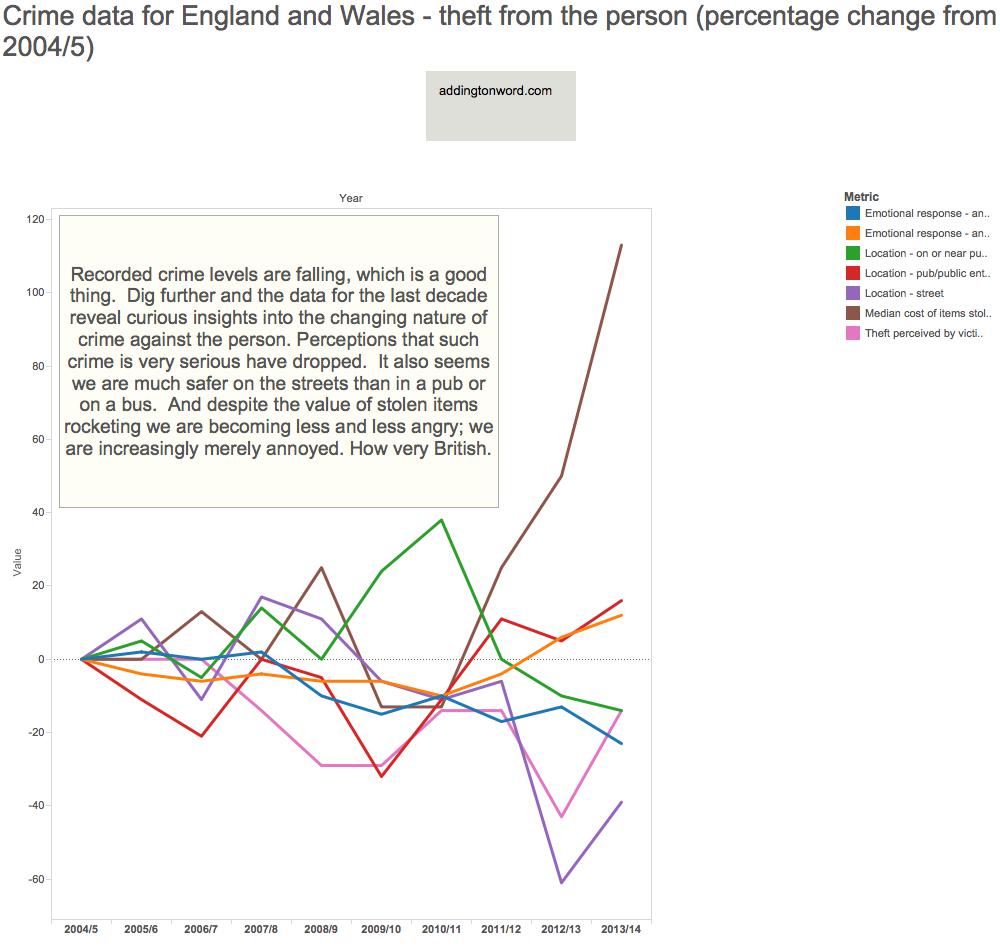
  • To interact with this data sheet click here.

    According to the recently released Crime Survey of England and Wales recorded crime levels are falling, which is a good thing. Dig further and the data for the last decade reveal curious insights into the changing nature of crime against the person. Perceptions that such crime is very serious have dropped. It also seems we are much safer on the streets than in a pub or on a bus. And despite the value of stolen items rocketing we are becoming less and less angry; we are increasingly merely annoyed. How very British.

    Crime data story

  • CIA-made-doctors-torture--009The report into the CIA’s detention and interrogation programme is a grim read. Not because it is 524 pages long, or that this heavily redacted offering to the public is tiny compared to the more than 6,700 pages of the full classified Committee Study. Rather, it is grim because it is real. Think Homeland was an exaggeration? Take a deep breath, click here and think again.

    The report describes individuals being waterboarded until the subject was “completely unresponsive, with bubbles rising through his open, full mouth”, how detainees were subjected to “rectal feeding without documented medical necessity”, “ice water baths” and how “a detainee who had been held partially nude and chained to a concrete floor died from suspected hypothermia” among many other graphic descriptions of cruelty. There is no point in listing here all the abuses; there are too many and the report too compelling, in a macabre way, for one’s attention to waiver. It is not a chore reading this document; for politicians and the security agencies it should be a duty.

    For clarity, the 12 ‘enhanced interrogation techniques’ used by the CIA were as follows: the attention grasp; walling; facial hold; facial slap; cramped confinement; wall standing stress positions; sleep deprivation; waterboarding; use of diapers (sic); use of insects; and mock burial.

    Defending the programme, Michael Hayden, Director of the CIA from 2006-2009, wrote a rebuttal to the report in the Daily Telegraph on 10th December. He suggested that the report was overly graphic in an attempt to shock. “So too,” he countered, “would an equally detailed description of drone strikes”. But this moral cut ‘n’ paste is indicative of how such a programme was allowed to exist, and go so wrong, for so many years. Liberal democracies accept that, occasionally, they must go to war and that this will involve killing and maiming people. The humanity comes from ensuring as far as possible that the right people are killed and that any such action takes place in a clearly defined and transparent legal framework. This humanity is notable by its absence from the Senate Committee’s report.

    The CIA’s legal position was that “the criminal prohibition on torture would not prohibit the methods proposed by the interrogation team because of the absence of any specific intent to inflict severe physical or mental pain or suffering”. This is splitting definitional hairs: without ‘specific intent’ how does anything happen? And who decides when the line is crossed into ‘severe’ pain?

    Apart from the graphic descriptions of abuse, the impression one is left with after reading the report is of an organisation pursuing an agenda of operational permissiveness unconcerned by outside scrutiny and actively seeking to avoid accountability.  In short, a complete failure of leadership. The glib manner in which Michael Hayden treated Congress when discussing detainee numbers is illustrative. The report details how, after Hayden had told Congress there were 98 detainees (in fact, there were 119) a CIA officer was instructed to pick a date that conformed to the 98 figure, so as to avoid suggestions of having misled Congress. The report further states: “Hayden did not view the discrepancy, if it existed, as particularly significant given that, if true, it would increase the total number by just over 10 percent.” As head of an organisation subjecting people to “near drownings” and “sleep deprivation…for up to 180 hours”, one might expect Hayden to know details such as exactly how many people this applied to.

    General David Morrison, head of the Australian army, recently issued a powerful reminder of the conduct expected from those bearing arms (see link here). In a little over three minutes his words encapsulate the values the CIA failed to uphold over nearly ten years. John Brennan, the current head of the CIA, refused this week to describe the actions as torture, although President Obama did. The word is irrelevant; the events need no introduction. The standard you walk past is the standard you accept.

  • reaper“We have not let technology run away with our ethics.”  So says a senior British Army Officer in the UK’s Ministry of Defence when quizzed about drones; the catch-all descriptor for unmanned aerial vehicles. But his comment hints at a nervousness in senior political and military circles of an erosion of public support due to the state’s perceived heavy-handed use of technology.

    Drones have been getting a bad press lately.  Once hailed as the antidote to messy ground-holding military deployments they now epitomise that sensitive and contested area where technology and ethics overlap.  The Bureau of Investigative Journalism claims drones were responsible for between 282 and 535 civilian deaths in President Obama’s first three years in office.   But politicians, wary of a public prone to rapid judgements when flag-draped coffins fill the front pages and impatient for “quick wins” as Philip Hammond, the former British Defence Secretary, explained to the Munich Security Conference on February 1st 2014, regularly hail a technology deemed invulnerable and, more importantly, precise.

    But there are two problems with claims of precision.  First, in a military context it implies infallibility.  True, technical sophistication has resulted in a marked increase in the use of so-called precision guided munitions (PGM): in Operation Desert Storm in 1991 8% of US aerial attacks employed PGMs; in Iraq in 2003 it was 68%.  But they do not always land where intended as much can influence a munition in flight.  Weather, faulty technology and human error in the construction of the weapon, weapon platform or targeting equipment can all influence where a payload lands, regardless of how stable the cross-hairs have been held on a target.

    The second problem is the suggestion that the West marks its own homework when it comes to accounting for the employment of lethal technology.  The military uses the term Circular Error Probable (CEP) to describe precision, defining it as a circle radius around a target within which 50% of weapons should fall. Modern PGMs have very small CEPs, usually less than 13 metres, achieving an accuracy military planners have long desired.  But the significant downside to PGMs is the unwritten part of the definition: half the munitions will not land in the CEP and the margin they will miss by is unquantifiable. In other words, they can land anywhere and still be described as a ‘precise’ weapon.  Critics say this qualification lets politicians and the military off the ethical hook too easily and is a significant factor in the anger felt by those subject to such bombardment.

    However, public anger towards drone strikes is as nothing compared to the outrage generated by the NSA and GCHQ cyber-spying revelations by Edward Snowden, the exiled former NSA contractor wanted for espionage in the US. But the real threat to the US and UK administrations from these allegations of global-scale mis-use of technology is that it has united the political left and right: left because of the affront to civil liberties, right due to the perceived scant regard for Congressional or Parliamentary oversight. Politicians abhor ceding the agenda, particularly where national security is concerned. Gisela Stuart, a British MP and member of the House of Commons Defence Select Committee, is all for the ethical use of lethal technology – she led a recent Parliamentary debate into drones – but is forthright in her defence of its ultimate purpose: “At the end of the day I don’t want you to give me a hanky to wipe away the blood, I’d prefer you to make sure it’s not there in the first place.”  The arms race between ethics and technology looks set to continue for some time yet.